

The Importance of Online Visibility for SaaS
In a crowded digital marketplace, online visibility is the most significant factor in a product’s success. SaaS founders must ensure their tools are discoverable where potential customers are already looking.
One of the most effective ways to achieve this is through SaaS directories. These platforms serve as a bridge between software providers and businesses seeking specific digital solutions.
The Challenge of Finding Free Options
When searching for free SaaS directories, users often encounter platforms that appear free but require payment for active listings. This can be frustrating for marketing managers working with tight launch budgets.
Many directories have moved toward a “freemium” model. While they might allow a basic listing, they often prioritize paid submissions or sponsored profiles in their search results and category pages.
Evaluating Paid Directory Submission Opportunities
Understanding the difference between free and paid SaaS directories is vital for growth strategists. Paid options generally offer faster indexing, verified badges, and higher placement in competitive categories.
These paid directory submission opportunities can provide a significant boost to lead generation. By investing in premium listings, startup executives can bypass long waiting queues and gain immediate exposure.
Strategic Growth Through Listings
This guide explains how to navigate these choices to improve product visibility. Choosing the right mix of platforms ensures that your marketing efforts result in high-quality traffic and conversions.
Focusing on high-authority directories will enhance your SEO and brand credibility. Balancing organic outreach with strategic paid placements is the most efficient path to scaling a new SaaS product.
What Are SaaS Directories?
SaaS directories are specialized online platforms that catalog and categorize software-as-a-service products based on their industry, function, or target audience. These digital hubs serve as a centralized resource for businesses and individuals searching for specific software solutions to solve operational challenges.
These platforms act as a bridge between software developers and potential users. By listing your tool on reputable SaaS directories, you place your product in a curated environment where decision-makers actively look for new tools.
Visibility and Brand Awareness
Listing your product on high-traffic directories increases your brand’s footprint across the web. It ensures that your startup appears in search results even if your primary website is not yet ranking for competitive industry terms.
Building High-Quality Backlinks
Most SaaS directories provide a link back to your product’s website. These backlinks are essential for search engine optimization, as they signal to search engines that your site is a credible and authoritative source within the software niche.
Generating Referral Traffic
Unlike general search traffic, visitors on these platforms are often further down the sales funnel. They are actively comparing options, which leads to high-quality referral traffic that is more likely to engage with your product’s features.
Reaching Potential Customers
SaaS directories allow you to reach a targeted audience of SaaS founders and marketing managers. By appearing in the right category, you position your software directly in front of the users who need your specific functionality the most.
Why Founders Search for Free SaaS Directories
SaaS startups often operate on lean budgets where every dollar must be strategically allocated. Utilizing free SaaS directories is a common move for founders to gain initial market traction without the burden of upfront costs.
These platforms allow growth strategists to reach specific niche audiences without competing in expensive paid advertising auctions. This accessibility makes directory listings a cornerstone of many early-stage marketing frameworks.
Maximizing Limited Marketing Budgets
Most early-stage companies prioritize product development and engineering over large-scale advertising spend. Free listings provide a low-risk entry point into the competitive software market.
By leveraging these directories, marketing managers can save their limited capital for other critical areas. This approach allows for sustainable growth while the product is still in its refining stages.
The Triple Benefit: Exposure, SEO, and Awareness
First, these platforms offer immediate product exposure to users actively searching for new software solutions. This targeted traffic often consists of high-intent leads ready to trial new tools.
Second, securing early backlinks from reputable directories is vital for long-term SEO. These links signal authority to search engines, helping your primary domain rank higher for relevant industry keywords.
Finally, a consistent presence across multiple sites builds essential brand awareness. It ensures your startup appears alongside established competitors, creating a sense of legitimacy and industry presence.
Testing Visibility and Market Fit
Many founders use free listings as a testing ground to see how their value proposition resonates with the public. It serves as a cost-effective way to gather preliminary data on user interest.
Monitoring the performance of these listings helps growth strategists identify which messaging drives the most engagement. This data is invaluable before committing to larger, paid marketing campaigns or premium directory placements.
The Common Reality: Free Searches Lead to Paid Submissions
Many founders begin their growth journey by searching for free SaaS directories to build initial domain authority. While these lists promise cost-free visibility, the actual submission process often reveals a different financial reality.
Most platforms operate on a freemium model that complicates the “free” aspect of the listing. This shift in the landscape requires marketing managers to be more discerning about where they spend their time.
The Illusion of the Free Basic Listing
Many directories allow you to submit your product details without an upfront fee. However, these basic listings are often buried deep within the site architecture where they receive almost no organic traffic.
To gain any meaningful traction, these platforms frequently charge for “featured” placements. Without paying for a top-tier spot, your software may remain invisible to the directory’s primary audience.
Paid Submissions for Faster Approval
Another common hurdle is the discrepancy in review timelines between free and paid tiers. While a submission might be technically free, the manual review queue for non-paying users can span several months.
Directories often prioritize “expedited” or “fast-track” submissions for a one-time fee. This forces growth strategists to choose between waiting indefinitely or paying to ensure the listing goes live quickly.
Confusion and Wasted Time for Teams
This bait-and-switch dynamic can lead to significant frustration for startup executives and marketing teams. Spending hours tailoring descriptions and uploading assets only to encounter a paywall at the final step is a common experience.
This lack of transparency results in wasted administrative resources and skewed expectations for lead generation. Understanding these hidden costs is essential for planning an efficient and realistic product launch strategy.
Free vs. Paid SaaS Directories: Key Differences
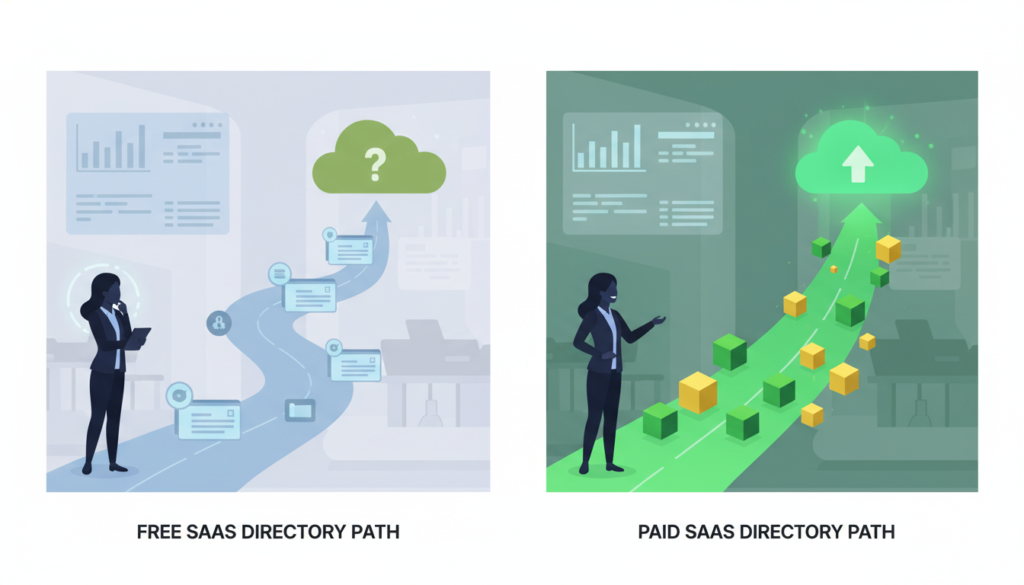
Choosing between free and paid SaaS directories is a pivotal decision for any growth strategist. Each path offers distinct advantages depending on your current budget and immediate marketing goals.
Free Directories
The most obvious benefit of free listings is that there is no cost for listing your product. This allows startups to build a presence across multiple platforms without draining their initial marketing budget.
However, these platforms often come with a significantly slower approval process. Because they are flooded with submissions, it can take weeks or even months for your profile to go live.
You should also expect limited exposure on these sites. Without a financial commitment, your software often remains buried under hundreds of competitors, making it difficult for potential leads to find you.
From a technical standpoint, free listings provide basic SEO value. They offer a backlink and a place for your brand name to appear, which helps build foundational domain authority over time.
Paid Directories
Paid options require submission fees, which can range from small one-time payments to recurring monthly subscriptions. This investment is often seen as a shortcut to gaining immediate market traction.
One of the primary perks of this model is faster listing approval. Paying for a spot usually moves your application to the front of the queue, ensuring your product is visible to the public within days.
These directories also offer featured placements on their homepage or at the top of category pages. This prime real estate ensures your brand stays top-of-mind for users browsing specific software solutions.
Ultimately, paid listings offer higher visibility and traffic potential. By investing in these platforms, you secure better positioning that drives qualified leads directly to your conversion pages.
When Paid SaaS Directory Submissions Are Worth It
Deciding between free and paid options is a common challenge for growth teams. While free listings offer basic visibility, strategic SaaS directory submissions on a paid basis can significantly accelerate your go-to-market timeline.
During product launches
Timing is critical when introducing a new tool to the market. Paid submissions often guarantee faster review times, ensuring your product is live during your peak promotional window.
This immediate presence helps capture early adopters who are actively scouring directories for new solutions. It prevents your launch momentum from stalling due to long manual approval queues.
When targeting high-authority backlinks
Many top-tier directories offer “dofollow” links only to their premium or paid members. These high-authority signals are essential for improving your domain rating and organic search rankings.
Investing in these listings acts as a long-term SEO play. The referral traffic is valuable, but the equity passed to your site helps you rank for competitive industry keywords.
When seeking premium exposure
Paid tiers often include featured placements, homepage spotlights, or category-top positioning. This ensures your software stays above the fold where potential buyers are most likely to click.
Premium exposure also builds trust through association. Being featured alongside established industry leaders enhances your brand’s perceived authority and credibility among decision-makers.
When marketing budgets allow faster growth strategies
If your startup has secured funding or has a healthy marketing budget, paid submissions are a scalable way to buy time. They bypass the slow burn of traditional organic directory growth.
This approach allows marketing managers to focus on conversion optimization rather than manual outreach. It is a predictable way to generate a steady stream of qualified leads and trial signups.
Paid SaaS Directories to Consider
Investing in paid SaaS directories is a strategic move for founders who want to bypass long wait times and gain immediate traction. While free listings offer baseline value, premium options provide the high-intent traffic and authority necessary for scaling a startup quickly.
These paid directories can provide stronger exposure and quicker visibility compared to free listings. By prioritizing these platforms, you ensure your product appears in front of decision-makers who are actively looking to purchase new software solutions.
G2 (Premium Profiles)
Website URL: g2.com
Submission Price: Custom annual pricing (often starting in the low thousands).
Key Benefits: Access to advanced buyer intent data, lead generation forms, and the ability to remove competitor ads from your profile page.
Capterra (Gartner Digital Markets)
Website URL: capterra.com
Submission Price: Pay-per-click (PPC) model.
Key Benefits: Massive monthly traffic and high-intent buyers. Being part of the Gartner network also includes listings on GetApp and Software Advice for broader reach.
SaaSHub (Premium)
Website URL: saashub.com
Submission Price: Approximately $49 per month for premium features.
Key Benefits: Enhanced visibility in “alternative to” searches and competitor comparison pages. It also provides a valuable “do-follow” backlink for SEO.
BetaList (Expedited Review)
Website URL: betalist.com
Submission Price: Starting at $129 for expedited processing.
Key Benefits: Skips the long editorial queue, ensuring your startup is featured within 48 hours. This is ideal for generating early adopter buzz during a launch.
Startup Stash (Featured Listing)
Website URL: startupstash.com
Submission Price: Approximately $95 for a featured spot.
Key Benefits: One of the most curated directories for entrepreneurs. A featured listing places your tool at the top of its category, significantly increasing click-through rates.
AppSumo
Website URL: appsumo.com
Submission Price: Revenue share model (percentage of sales).
Key Benefits: Unrivaled exposure to a massive community of software buyers. It serves as both a directory and a powerful distribution channel for rapid user acquisition.
Paid SaaS Directories Lsit:
How to Choose the Right SaaS Directory
Selecting the most effective SaaS directory requires a strategic approach to ensure a high return on investment. Not every platform will align with your specific growth goals or target audience.
Domain Authority
Prioritize platforms with a high Domain Authority (DA) score. High-authority sites are viewed as more trustworthy by search engines, which enhances the credibility of your listing.
Listing your product on a site with strong authority helps improve your own site’s search engine rankings. Use SEO tools to verify these metrics before committing your resources.
Website Traffic
A directory is only as valuable as the audience it attracts. Research the monthly visitor count to ensure your product will receive sufficient visibility from potential buyers.
High traffic volume increases the likelihood of click-throughs to your landing page. Focus on platforms that demonstrate consistent growth in their own user base.
Relevance to Your SaaS Niche
Relevance is often more important than raw traffic numbers. A smaller, niche-specific directory frequently yields higher conversion rates than a massive, generalized platform.
Ensure the directory serves the specific industry or problem your software solves. This alignment ensures that the leads generated are high-quality and ready to buy.
Pricing vs Exposure Value
Evaluate the cost of featured listings or premium placements against the expected exposure. Some platforms offer free tiers, while others require significant monthly investments.
Calculate the potential cost-per-lead based on the directory’s historical performance data. Choose the option that balances budget constraints with maximum brand reach.
SEO Benefits
Analyze whether the directory provides “dofollow” or “nofollow” links to your website. Dofollow links are essential for passing link equity and boosting your organic search performance.
Beyond backlinking, consider how the directory categorizes its listings. Proper categorization helps search engines understand your product’s context and improves your overall digital footprint.
Conclusion
Navigating the landscape of SaaS directories is a fundamental step for any founder looking to increase product visibility. These platforms serve as a vital bridge between your software and potential users searching for specific solutions.
Free directories are an excellent starting point for early-stage companies. They provide a cost-effective way to generate backlinks and establish a baseline digital presence without depleting your initial marketing budget.
Maximizing Visibility with Paid Options
While free listings are valuable, paid directories often provide better visibility and faster results. Investing in premium placements ensures your product remains at the top of competitive categories where organic reach is limited.
Paid options frequently include advanced features like lead tracking and enhanced profiles. These tools allow marketing managers to gather better data on user behavior and optimize their conversion funnels more effectively.
Finding the Right Balance
The most successful growth strategies typically involve a balanced approach. By leveraging both free and paid platforms, you create a diversified lead generation engine that supports both short-term wins and long-term authority.
SaaS founders should focus on high-quality platforms that align closely with their specific niche. Maintaining consistency across all listings will ultimately lead to better search engine rankings and a more sustainable pipeline of qualified leads.






Add comment