

Introduction: Demystifying Guest Posting
Guest posting remains one of the most effective strategies for building online authority and improving search engine rankings. By contributing high-quality content to other websites, you can tap into established audiences and build valuable industry connections.
In the modern digital marketing landscape, guest posting serves as a bridge between content creation and strategic link building. It allows you to showcase your expertise while earning the trust of both users and search engine algorithms.
What Exactly is Guest Posting?
Definition and core concept
At its simplest, this practice involves writing an article or blog post to be published on someone else’s website or blog. You act as a “guest” contributor, providing insights that align with the host site’s editorial standards.
The reciprocal value proposition (writer & host)
This is a mutually beneficial arrangement where the writer receives exposure and backlinks, while the host gains fresh, relevant content. It strengthens the content ecosystem by sharing diverse perspectives and expert knowledge across different platforms.
Why Guest Posting Matters in Today’s Digital Landscape
SEO benefits (backlinks, domain authority)
Securing links from reputable sites signals to search engines that your own website is a trustworthy source of information. These backlinks are a primary ranking factor that can significantly boost your overall domain authority.
Brand visibility and thought leadership
Publishing on high-traffic industry sites places your brand in front of a wider demographic. Over time, consistent contributions establish you as a thought leader and a go-to expert in your specific niche.
Referral traffic and audience growth
Beyond SEO, a well-placed link within a guest post can drive direct, highly targeted referral traffic to your site. This often leads to higher conversion rates because the audience already trusts the host platform.
Networking opportunities
Collaborating with other site owners and editors opens doors for future partnerships and professional relationships. It integrates you into the community of influencers and creators within your industry.
The Guest Posting Process: A Step-by-Step Breakdown
Step 1: Defining Your Goals and Niche
Clarifying your objectives (SEO, traffic, branding)
Before reaching out to editors, determine exactly what you want to achieve. Are you looking for high-authority backlinks, or is your primary goal to drive immediate sales and traffic?
Identifying your target audience
You must understand who you are writing for to ensure your content resonates. Choose host sites that share a similar demographic to your ideal customer or reader to maximize the impact of your efforts.
Understanding your unique value proposition
Define what sets your insights apart from the competition. Editors are more likely to accept your pitch if you offer a fresh perspective or data-backed insights that their audience hasn’t seen before.
Step 2: Finding High-Quality Guest Post Opportunities
Google search operators (e.g., “write for us” + niche)
Use advanced search strings like “your niche” + “guest post” or “your niche” + “contributor guidelines.” This quickly filters the web for sites actively looking for external writers.
Competitor backlink analysis
Use SEO tools to see where your competitors are publishing guest content. If a site has accepted a post from a competitor, they are likely open to hearing from other experts in the same field.
Social media and industry communities
Monitor hashtags like #GuestPost or join LinkedIn and Facebook groups dedicated to niche blogging. These communities often share leads on sites currently seeking fresh content.
Guest posting platforms and marketplaces (cautionary note)
While marketplaces can save time, use them with caution to avoid low-quality “link farms.” Prioritize manual outreach to ensure the sites you work with maintain high editorial standards and genuine traffic.
Vetting potential sites (DA, traffic, relevance, audience)
Always check a site’s Domain Authority (DA) and monthly traffic before pitching. Ensure their content is relevant to your niche and that their audience engages with the posts through comments or social shares.
Step 3: Crafting the Perfect Pitch
Personalization and research
Avoid generic templates that look like spam. Mention a specific article you enjoyed on their site to prove you have actually researched their content and understand their style.
Subject line best practices
Your subject line should be clear and professional. Use formats like “Guest Post Pitch: [Proposed Title]” to ensure the editor knows exactly what the email is about before opening it.
Proposing relevant topic ideas (with unique angles)
Suggest two or three specific topics that fill a gap in the host’s current content library. Provide a brief summary of what each article will cover to show the value you intend to deliver.
Showcasing your expertise (portfolio, bio)
Briefly explain why you are qualified to write on the topic. Include links to previously published work to demonstrate your writing quality and your ability to follow editorial guidelines.
Call to action
End your pitch with a clear next step, such as asking if they would like to see a rough draft or an outline. Keep it polite and professional to encourage a positive response.
Step 4: Writing Compelling Guest Content
Adhering to editorial guidelines
Every site has its own rules regarding word count, formatting, and tone. Strictly following these guidelines increases the chances of your post being accepted without heavy revisions.
Focusing on value and originality
Provide actionable advice, unique case studies, or new data. Avoid rehashing basic information that can be found anywhere else on the internet; give the readers something they can actually use.
Optimizing for SEO (keywords, internal/external links)
Naturally integrate relevant keywords and include internal links to the host site’s previous articles. This helps the host’s SEO and shows that you are invested in the success of their platform.
Including a strong author bio with a backlink
Your bio is where you claim your credit. Write a concise description of who you are and include a link back to your website or a specific landing page to capture the referral traffic.
Step 5: Post-Publication Engagement and Promotion
Sharing the live post
Once the post is live, promote it across your own social media channels and email newsletters. This drives traffic to the host site, which builds goodwill with the editor for future collaborations.
Engaging with comments
Monitor the comments section of your guest post and respond to readers’ questions. Active engagement shows you are a real person and helps build a deeper connection with the new audience.
Leveraging the content for further promotion
Use the published post as a portfolio piece for future pitches. Mentioning your successful contributions to high-profile sites makes it much easier to secure even better guest posting opportunities in the future.
Best Practices for Guest Posting Success
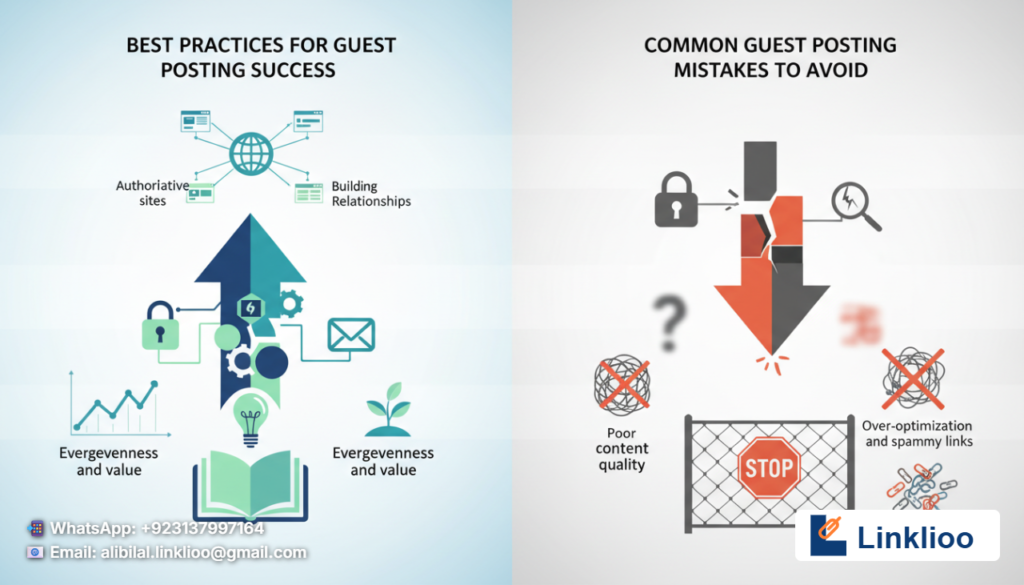
Effective guest posting is a cornerstone of modern digital marketing. It allows you to tap into established audiences while building your brand’s authority and search engine visibility.
To see real results, you must move beyond simple link building. Success requires a strategic approach that prioritizes long-term growth over quick, low-quality wins.
Quality Over Quantity
Many marketers make the mistake of chasing volume. However, one high-quality placement is worth more than dozens of mentions on obscure, low-traffic websites.
Focus on authoritative and relevant sites
Target websites that possess high domain authority and a readership that matches your niche. Relevance ensures that the traffic you drive back to your site is actually interested in your services.
Avoid spammy or low-quality directories
Stay away from “article farms” or sites that exist solely to sell links. Search engines easily identify these patterns and may penalize your site for associating with them.
Building Relationships
Guest blogging is fundamentally about networking. When you approach a site owner, you are proposing a partnership that should benefit both parties and their respective audiences.
Nurturing connections with editors and bloggers
Treat every interaction with an editor as the start of a professional relationship. Polite communication and timely responses can lead to recurring opportunities and future collaborations.
Reciprocal sharing and support
Once your post is live, promote it across your own social channels. Supporting the host site shows that you are invested in their success, not just your own backlink.
Content Evergreenness and Value
The best guest contributions continue to drive traffic years after they are published. This requires a focus on substance rather than chasing temporary trends.
Creating content that remains relevant over time
Write about core principles, “how-to” guides, or industry standards. Evergreen content ensures your brand remains a thought leader as new readers discover your work daily.
Providing unique insights and actionable advice
Avoid regurgitating basic information found elsewhere. Offer specific data, personal case studies, or unique frameworks that readers can implement immediately to see results.
Common Guest Posting Mistakes to Avoid
Even experienced marketers can fall into traps that undermine their outreach efforts. Avoiding these common pitfalls will protect your reputation and improve your acceptance rates.
Generic Pitches and Lack of Research
Editors receive hundreds of emails daily. A “one-size-fits-all” pitch is the fastest way to get your message moved to the trash folder without being read.
Not personalizing emails
Address editors by name and mention specific articles they have recently published. This demonstrates that you have actually visited their site and understand their editorial voice.
Proposing irrelevant topics
Pitching a tech article to a lifestyle blog shows a lack of preparation. Ensure your topic aligns perfectly with the host’s categories and audience interests.
Poor Content Quality
The quality of your guest post reflects directly on your brand. Submitting subpar work suggests that your own products or services may also lack professional standards.
Submitting unedited or low-value articles
Always proofread your work or use a professional editor. Grammatical errors and logical inconsistencies frustrate editors and lead to immediate rejection of your draft.
Ignoring editorial guidelines
Most reputable sites have specific formatting and style rules. Ignoring these guidelines creates extra work for the editor and signals that you are difficult to work with.
Over-optimization and Spammy Links
While SEO is a primary goal, over-optimizing your content can trigger red flags for both editors and search engine algorithms. Balance is key to maintaining integrity.
Keyword stuffing
Forcing keywords into your text disrupts the reading experience. Write for humans first, ensuring that your primary terms appear naturally within the context of the information.
Excessive or irrelevant backlinks
Limit your self-promotional links to one or two highly relevant sources. Including too many links or linking to unrelated pages makes the content look like an advertisement rather than an educational resource.
Measuring the ROI of Your Guest Posting Efforts

Determining the success of your guest posting strategy requires looking far beyond the simple acquisition of a backlink. To truly understand your return on investment, you must evaluate how each contribution moves the needle for your business goals.
An authoritative approach to measurement ensures you are not just shouting into the void, but building a sustainable digital asset. By analyzing specific data points, you can refine your outreach and focus on high-performing platforms.
Key Metrics to Track
Tracking the right data allows you to distinguish between a vanity project and a high-impact marketing campaign. Focus on these four pillars to gauge your performance accurately.
Referral traffic
Monitor how many users click through from the guest piece to your own website. High-quality referral traffic often indicates that the host site’s audience is perfectly aligned with your target demographic.
Backlink acquisition and domain authority improvement
A primary goal of guest blogging is strengthening your site’s SEO profile. Track the number of do-follow links gained and observe changes in your Domain Authority (DA) or Domain Rating (DR) over time.
Brand mentions and social shares
Even without a direct link, brand mentions build authority and trust with search engines. Observe how often your content is shared on social platforms to measure its resonance and reach within the industry.
Lead generation/conversions
The ultimate measure of ROI is whether the traffic converts into tangible leads or sales. Use UTM parameters to track visitors from specific guest posts through your entire sales funnel.
Tools for Analysis
To gather accurate data, you must utilize professional-grade software that tracks both on-site behavior and off-site SEO health.
Google Analytics
Google Analytics is essential for monitoring referral traffic and conversion paths. It allows you to see exactly what visitors do after they land on your site from an external contribution.
SEO tools (Ahrefs, SEMrush, Moz)
These platforms are vital for tracking keyword rankings and backlink profiles. They provide deep insights into how your guest posts are influencing your overall search engine visibility and competitive standing.
Conclusion: Harnessing the Power of Guest Posts
Mastering the art of guest blogging is a transformative step for any digital marketer or entrepreneur. When executed with precision, it serves as a multi-faceted tool for growth, networking, and search engine dominance.
By shifting your focus from quantity to quality, you ensure that every word written contributes to long-term brand equity. Success in this field is reserved for those who prioritize value for the reader above all else.
Recap of Key Takeaways
Reviewing your progress helps solidify your strategy and ensures you remain on the path toward your marketing objectives.
Strategic importance of guest posting
Guest blogging remains one of the most effective ways to build authority and reach new audiences. It bridges the gap between content creation and relationship building in the digital space.
Emphasize consistent effort and quality
One-off posts rarely yield significant results; consistency is the engine of SEO growth. High-quality content will always outperform low-tier, high-volume submissions in the eyes of both users and algorithms.
Your Next Steps in Guest Blogging
The transition from planning to execution is where most marketers stumble. Now is the time to apply these insights to your own growth strategy.
Encourage readers to start their outreach
Begin by identifying high-authority sites within your niche that align with your brand values. Draft your first round of personalized pitches and start building the connections that will define your future online presence.







One comment
Pingback:
Mastering Guest Post Outreach: Your Guide to New York Blogs - Linklioo