

Introduction to SaaS Directory Submission in 2026
In the rapidly shifting landscape of software marketing, SaaS Directory Submission remains a cornerstone of a robust digital growth strategy in 2026.
As search engines prioritize intent and authority, placing your product in front of the right audience requires more than just a website.
Directories have evolved into sophisticated ecosystems where buyers research, compare, and finalize their software stacks.
What is SaaS Directory Submission?
Definition and Purpose
SaaS directory submission is the strategic process of listing your software product on curated platforms like G2, Capterra, or niche-specific aggregators.
The primary purpose is to increase discoverability and provide social proof through user reviews and structured data.
These listings serve as a bridge between your product and high-intent buyers looking for specific solutions.
Evolution of Directory Submissions (Past vs. Present)
Years ago, directories were often viewed as mere repositories for low-quality backlinks and SEO manipulation.
Today, they are high-authority marketplaces driven by AI-powered search filters and deep integration with the software buying journey.
Modern submissions focus on data accuracy, user sentiment, and category leadership rather than just link quantity.
Why it Matters for SaaS Growth in 2026
Enhanced SEO and Backlinks
High-quality directories provide powerful links that signal domain authority and relevance to modern search algorithms.
In 2026, these citations are essential for maintaining a competitive edge in high-difficulty search engine results pages.
They help build a diverse backlink profile that protects your site against volatility in organic search rankings.
Increased Brand Visibility and Trust
Being featured alongside industry leaders builds immediate credibility for emerging SaaS startups and established brands alike.
Positive ratings and detailed profiles serve as a trust signal that reduces friction during the customer’s decision-making process.
A strong presence across multiple directories ensures your brand remains top-of-mind during the research phase.
Targeted Lead Generation
Users visiting these directories are typically in the consideration or decision phase of the marketing funnel.
This high-intent traffic often results in higher conversion rates compared to cold outbound or general display advertising.
Directories allow you to capture demand exactly when a user is looking for a tool with your specific feature set.
Who Should Read This Guide?
SaaS Founders and Marketing Teams
Founders need to understand how directory placement impacts their overall market positioning and long-term brand equity.
Marketing teams can use these insights to streamline their distribution efforts and maximize their return on investment.
This guide provides the framework for turning directory profiles into active revenue-generating assets.
SEO Specialists
For SEO professionals, this guide provides a roadmap for securing high-authority mentions that bolster organic search performance.
It highlights the technical nuances of profile optimization, keyword alignment, and referral traffic tracking.
Understanding the current state of directory algorithms is vital for any off-page SEO strategy.
Growth Hackers
Growth marketers will find actionable strategies for leveraging directory traffic to scale user acquisition rapidly.
This content focuses on turning directory listings into a consistent, predictable engine for product growth and experimentation.
By optimizing these channels, growth hackers can lower customer acquisition costs while increasing lead quality.
The Strategic Benefits of SaaS Directory Listings
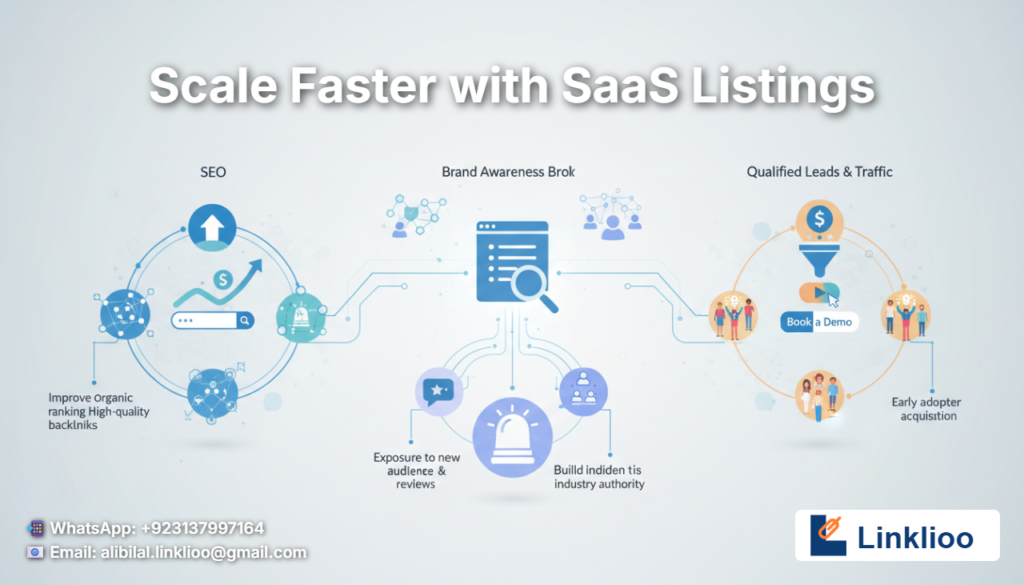
Leveraging SaaS directory listings is a foundational strategy for modern software companies looking to scale their digital footprint. These platforms act as high-authority intermediaries that connect your product with a targeted audience of decision-makers.
By securing placements on reputable directories, you establish a presence where your customers are already searching. This approach provides a multi-layered advantage, impacting your search visibility, brand reputation, and bottom-line revenue.
Boosting Your Search Engine Optimization (SEO)
Search engines prioritize websites with strong backlink profiles and clear topical relevance. Directories provide the structural support needed to signal to algorithms that your software is a legitimate player in its category.
High-Quality Backlinks and Domain Authority
Most established directories possess high Domain Authority (DA) and provide powerful “do-follow” or “no-follow” links. These links pass equity to your site, helping to increase your own domain’s ranking potential over time.
Local SEO and Niche Relevance
If your SaaS serves specific regions or niche industries, specialized directories provide critical local signals. This categorical relevance helps search engines understand exactly which user queries your software should satisfy.
Improved Organic Rankings
Appearing on top-tier directory lists often results in “piggyback SEO.” Since these directories often rank for high-volume keywords, being listed ensures your brand appears on page one, even if your own site hasn’t reached that position yet.
Driving Brand Awareness and Credibility
In a crowded market, trust is a primary differentiator. Directories provide a neutral third-party environment where your brand can build a reputation based on performance and user feedback.
Exposure to New Audiences
Directories attract thousands of monthly visitors specifically looking for software solutions. This puts your product in front of growth marketers and IT managers who may not have discovered you through traditional search.
Social Proof and User Reviews
The review sections of these platforms serve as a vital source of social proof. Positive testimonials from verified users mitigate the perceived risk for new buyers and influence their final purchasing decisions.
Building Industry Authority
Being featured alongside industry leaders validates your product’s standing in the market. This association helps position your SaaS as a professional, reliable solution within your specific vertical.
Generating Qualified Leads and Traffic
Beyond visibility, directories are high-intent conversion engines. Users browsing these sites are typically in the consideration or decision phase of the buyer’s journey, making them highly valuable.
Direct Referral Traffic
Directory listings drive consistent, high-intent referral traffic to your landing pages. Because these visitors are already looking for a solution, they often demonstrate lower bounce rates and higher engagement levels.
Conversion Opportunities
Many platforms allow for direct “Book a Demo” or “Start Free Trial” buttons on your profile. This reduces friction in the user journey, allowing prospects to enter your sales funnel directly from the directory.
Early Adopter Acquisition
For new products, directories are a magnet for early adopters and tech-savvy founders. These users are often willing to provide feedback and become advocates, helping you refine your product-market fit rapidly.
Types of SaaS Directories to Target
Identifying the right SaaS directories is a strategic move for any software company aiming to scale its organic reach. These platforms act as high-authority hubs that connect your product with decision-makers and high-intent buyers.
By diversifying your presence across various directory types, you can capture traffic at every stage of the marketing funnel. This approach ensures your product remains visible to both general business users and niche technical specialists.
General Business Directories
Examples: Google My Business, Yelp, Yellow Pages
While often associated with local retail, platforms like Google My Business and Yelp are valuable for establishing corporate legitimacy. They provide a foundational layer of trust and help anchor your brand in localized search results.
Benefits and Limitations
These directories offer massive domain authority, which can boost your overall SEO profile through high-quality backlinks. However, they lack the granular filtering and technical specifications that software buyers typically require during the evaluation process.
Niche SaaS and Software Directories
Examples: G2, Capterra, Software Advice, GetApp, Product Hunt
Industry leaders like G2 and Capterra are essential for any SaaS growth strategy. Product Hunt serves as a critical launchpad for new features, while GetApp and Software Advice cater to professionals looking for specific workflow solutions.
Importance of Industry-Specific Platforms
These platforms are designed specifically for software procurement, attracting users who are actively looking to solve a problem. Presence on these sites puts your product directly in front of high-intent leads who are ready to convert.
Review Sites and Comparison Platforms
The Power of User-Generated Content
User reviews serve as powerful social proof that can significantly shorten the sales cycle. Prospective customers often trust peer feedback on comparison sites more than the marketing copy found on your own website.
Managing Reviews and Ratings
Maintaining a high rating requires proactive engagement and a system for gathering customer feedback. Responding to reviews shows potential buyers that your team is attentive and committed to continuous product improvement.
Startup and Tech-Focused Directories
Examples: Crunchbase, AngelList, Betalist
Crunchbase and AngelList are the primary resources for tracking company growth, funding rounds, and leadership teams. Betalist is a specialized platform for reaching early adopters who want to test new software before it hits the mainstream.
Visibility for Investors and Early Adopters
Being listed on tech-focused directories increases your visibility within the venture capital and startup ecosystems. These sites help you build a reputation among innovators and investors who can provide the capital or partnership opportunities needed for scaling.
Your 2026 Playbook for Effective SaaS Directory Submission

Executing a strategic SaaS directory submission campaign remains a cornerstone for software growth and authority in 2026. This process is no longer just about backlinks; it is about establishing a presence where your potential customers are actively comparing solutions.
By following a structured approach, you ensure your product stands out in a crowded marketplace. This playbook provides the framework needed to navigate preparation, execution, and long-term management of your listings.
Pre-Submission Preparation
Before you begin submitting to platforms like G2, Capterra, or Product Hunt, you must lay a solid foundation. High-quality preparation prevents wasted time and ensures your brand voice remains consistent across the web.
Defining Your SaaS Niche and USP
Identify exactly where your product fits in the software ecosystem. Clearly define your Unique Selling Proposition (USP) to differentiate your tool from established incumbents and emerging competitors.
Gathering Essential Information
Compile a media kit specifically for directory listings. This should include high-resolution logos, updated pricing tiers, and professional screenshots that showcase your user interface in action.
Crafting Compelling Product Descriptions
Write several versions of your product description, ranging from 50 to 500 words. Focus on benefits rather than just features, explaining how your SaaS solves specific pain points for your target audience.
The Submission Process: Step-by-Step
The submission phase requires precision and attention to detail. A poorly optimized profile can lead to lower search rankings within the directory and a lower conversion rate from visitors to leads.
Account Creation and Profile Optimization
Create accounts using a professional company email to establish credibility. Fill out every available field in the profile, as “complete” profiles often receive preferential treatment in directory internal search algorithms.
Keyword Research for Directory Listings
Research the specific terms users search for within these platforms. Directory SEO differs from Google SEO; focus on category-specific keywords and “alternative to” phrases that capture high-intent traffic.
Ensuring Consistency Across Platforms
Maintain “NAP” consistency—Name, Address, and Phone (or Profile details). Discrepancies in pricing or feature lists across different directories can confuse prospects and harm your brand’s perceived reliability.
Post-Submission Management
Your work does not end once the “submit” button is pressed. Active management of your directory presence is what separates successful SaaS companies from those that stagnate after the initial launch.
Monitoring Listings and Updates
Schedule monthly audits of your listings to ensure all information remains current. As you release new features or update your UI, reflect these changes immediately on all directory profiles to maintain accuracy.
Responding to Reviews
Engage with your users by responding to every review. Address negative feedback with professionalism and a solution-oriented mindset, and thank users for positive testimonials to build social proof and trust.
Leveraging Directory Features
Utilize the advanced tools offered by major directories. This includes displaying “Top Rated” badges on your website to boost conversion and considering targeted internal ads to increase visibility during high-growth phases.
Common Pitfalls and How to Avoid Them

Executing a successful SaaS directory submission strategy requires more than just filling out forms; it demands precision and a commitment to quality. Many growth marketers rush the process, leading to errors that can undermine their search engine rankings and brand reputation.
Inconsistent Information
Providing different details across various platforms is a frequent mistake that confuses both users and search engines. When your product description, pricing, or features vary from one site to another, it creates a fragmented brand image.
Impact on SEO and User Trust
Search engines rely on consistent data to verify the legitimacy of your business. Conflicting information can dilute your local SEO signals and lower your authority in search results.
For users, inconsistency signals a lack of professionalism. If a potential customer sees one price on a directory and another on your website, they may abandon the sign-up process entirely.
Tools for Consistency Checks
Maintaining a “source of truth” document, such as a master spreadsheet or a Notion database, ensures your team uses identical copy for every submission.
Automated tools like Yext or BrightLocal can also help monitor your listings across the web. These platforms alert you to discrepancies and allow for bulk updates to maintain data integrity.
Submitting to Low-Quality Directories
The “more is better” approach often backfires when SaaS founders submit their products to every available link farm. Quality always outweighs quantity in a modern SEO strategy.
Identifying Spammy vs. Authoritative Sites
Authoritative sites typically have a high Domain Rating (DR), active user communities, and a clear editorial review process. They provide genuine value to visitors looking for software solutions.
Spammy sites often have cluttered layouts, no clear niche, and an abundance of broken links. If a directory guarantees instant listing for a low fee without a review, it is likely a low-quality source.
Risk of Negative SEO
Search engines like Google are increasingly adept at identifying and discounting manipulative backlink patterns. Associating your SaaS with “link neighborhoods” can result in algorithmic penalties.
In the worst-case scenario, a surge of low-quality links can lead to a manual action. This significantly harms your visibility and requires an extensive backlink audit and disavow process to fix.
Neglecting Review Management
Many marketing managers treat directory submissions as a one-time task rather than an ongoing engagement channel. Directories are living ecosystems where user feedback can make or break your conversion rates.
The Cost of Unanswered Feedback
Negative reviews that go unaddressed suggest to prospects that your customer support is unresponsive. This silence can deter high-intent leads who are comparing you against more engaged competitors.
Even positive reviews require attention. Failing to acknowledge happy customers misses an opportunity to build brand advocates and strengthen your community presence.
Strategies for Proactive Engagement
Set up alerts for new reviews on major platforms like G2, Capterra, and TrustRadius. Assign a team member to respond to every comment within 24 to 48 hours.
Develop a library of response templates that can be customized. This ensures a consistent brand voice while allowing for the personalized touch that modern SaaS users expect.
Measuring Your Success: KPIs and Tools
To justify the time and budget spent on directory listings, you must track the right metrics. Measuring success allows you to double down on high-performing platforms and cut those that offer no return.
Key Performance Indicators (KPIs) to Track
Focusing on the right KPIs helps you understand how directory submissions contribute to your overall growth funnel. Quantitative data provides the clarity needed for strategic adjustments.
Referral Traffic from Directories
Monitor how many visitors are clicking through to your website from specific directory profiles. This metric helps you identify which platforms your target audience actually uses for research.
Backlink Growth and Domain Authority
Track the number of new, high-quality backlinks generated through your submission efforts. Over time, these links should contribute to an increase in your site’s overall Domain Authority or Domain Rating.
Lead Conversions and Sign-ups
The ultimate goal of any marketing effort is revenue. Use UTM parameters to track how many leads or free-trial sign-ups originate directly from your directory listings.
Brand Mentions and Sentiment
Observe how often your brand is mentioned in directory-hosted discussions or listicles. Tracking sentiment helps you gauge how the market perceives your product relative to competitors.
Essential Tools for Monitoring
Using a robust tech stack simplifies the tracking process and provides deeper insights into user behavior. These tools are standard for any data-driven SaaS marketing team.
Google Analytics (Traffic Sources)
Google Analytics is the primary tool for analyzing referral traffic. By filtering by “Source/Medium,” you can see exactly which directories are driving the most engaged visitors to your landing pages.
SEO Tools (Ahrefs, SEMrush for Backlinks)
Platforms like Ahrefs and SEMrush are essential for monitoring your backlink profile. They allow you to see when new links are indexed and provide alerts if any links are lost or removed.
Reputation Management Software
Software like Mention or specialized review trackers can aggregate feedback from across the web into a single dashboard. This streamlines the process of responding to users and maintaining a positive brand image.
The Future of SaaS Directory Submission Beyond 2026

As the digital landscape shifts toward decentralized discovery, SaaS directory submission remains a cornerstone of any robust growth strategy. However, the methods used today will likely be obsolete by 2026 as artificial intelligence and voice search redefine how users encounter new tools.
Founders and marketers must look beyond simple backlinks and focus on how platforms aggregate software data. The future of visibility lies in how well your product is understood by both humans and machines in a fragmented ecosystem.
Adapting to these changes now ensures your software remains visible as traditional search engines evolve into comprehensive answer engines.
The Rise of AI-Powered Discovery Platforms
How AI might change product search
Artificial intelligence is transforming product discovery from a manual browsing experience into a conversational one. Instead of scrolling through lists, users will ask LLMs to recommend tools based on specific workflows and budget constraints.
This shift means that directories will serve as primary data sources for AI training models. Your presence on these platforms is no longer just about direct traffic, but about being part of the AI’s knowledge base.
Adapting your listings for AI
To stay relevant, your directory listings must prioritize structured data and clear, objective value propositions. AI models favor precise information over marketing fluff when determining product fit for a user’s query.
Focus on defining your “jobs to be done” and technical specifications clearly. This allows discovery algorithms to accurately categorize your SaaS and recommend it during complex, multi-step user prompts.
Voice Search Optimization for SaaS
Implications for how users find software
Voice-activated assistants are becoming more sophisticated in handling B2B queries. Marketing managers and founders are increasingly using voice commands to perform initial market research while multitasking.
Voice search typically favors the top-rated or most relevant result, creating a “winner-takes-most” environment. If your SaaS isn’t optimized for these natural language queries, you risk being excluded from the conversation entirely.
Optimizing descriptions for natural language queries
Optimizing for voice requires a shift toward long-tail keywords and question-based content. Your directory descriptions should answer specific questions like “What is the best automated invoicing tool for freelancers?”
Using a conversational tone in your feature summaries helps voice engines parse your content more effectively. This increases the likelihood of your product being the verbal recommendation provided by AI assistants.
The Growing Importance of Personalization and Niche
Hyper-targeted directories
The era of the “everything directory” is fading as users seek specialized platforms tailored to their specific industry or tech stack. Hyper-targeted directories offer higher conversion rates because the audience intent is much more refined.
SaaS companies should prioritize submissions to niche-specific platforms where their core demographic spends time. This targeted approach improves lead quality and reduces the noise associated with general software marketplaces.
User experience as a ranking factor
Directories are increasingly using engagement metrics, such as click-through rates and time-on-page, to rank listings. A listing that provides a seamless, informative experience will naturally rise to the top of the internal search results.
High-quality visuals, interactive demos, and genuine user reviews are essential components of a high-ranking listing. Prioritizing the user’s journey within the directory will directly impact your visibility and authority.
Conclusion: Elevate Your SaaS Visibility in 2026 and Beyond
The evolution of software discovery demands a proactive and forward-thinking approach to how you present your product online. Staying ahead of the curve requires moving beyond static submissions toward dynamic, optimized presence.
Recap of Key Takeaways
AI and voice search are fundamentally changing the mechanics of product discovery. Success in 2026 will depend on how well your SaaS data is structured for these emerging technologies.
Niche platforms and user experience are becoming the primary drivers of high-quality traffic. By focusing on these areas, you can ensure your product remains a top choice in an increasingly crowded market.
Your Action Plan for Directory Submission Success
Begin by auditing your current listings to ensure they are concise and data-rich for AI consumption. Identify at least five niche-specific directories that cater to your primary user persona.
Update your descriptions to include natural language questions that your software solves. This simple shift can capture emerging voice search traffic that your competitors are likely overlooking.
Continuous Optimization for Lasting Impact
Directory submission is not a “set it and forget it” task; it requires ongoing refinement based on performance data. Monitor which platforms drive the highest quality leads and double down on those ecosystems.
As new discovery technologies emerge, remain agile and ready to pivot your strategy. Consistent optimization is the only way to maintain a competitive edge and ensure long-term growth for your SaaS.






Add comment