

Unlocking Startup Growth with SaaS Directory Submission
For early-stage companies, SaaS Directory Submission is a foundational pillar of a robust digital marketing strategy. It bridges the gap between a new product launch and sustainable organic search performance.
By listing your software on specialized platforms, you position your brand where potential users and search engine crawlers are most active. This process is essential for establishing an initial footprint in a competitive market.
What is SaaS Directory Submission?
Definition and Purpose
This process involves submitting your software product’s details to curated lists and platforms that categorize software-as-a-service solutions. The purpose is to provide a centralized location for users to discover, compare, and review tools.
Distinction from general business directories
Unlike general directories like Yelp or Yellow Pages, SaaS directories focus specifically on software functionality, integrations, and tech stacks. They cater to a B2B audience looking for specific digital solutions rather than local physical services.
Why SaaS Startups Can’t Ignore Directory Submission for SEO
Early-stage visibility challenges
New SaaS products often suffer from the “sandbox” effect, where search engines hesitate to rank a fresh domain. Directory listings provide immediate visibility while your main site builds the necessary authority to rank independently.
Foundation for organic growth
Directories act as a catalyst for your broader SEO strategy. They provide the initial signals search engines need to understand your product’s category, relevance, and industry standing.
The Core Benefits: How Directory Submission Fuels Your SaaS SEO
Strategic submissions do more than just list your name; they create a network of digital touchpoints that reinforce your site’s authority. Each listing serves as a permanent asset that contributes to long-term growth.
Enhanced Online Visibility and Brand Awareness
Reaching new audiences
Directories like G2, Capterra, and Product Hunt have massive, pre-existing audiences. Listing your product puts you directly in front of buyers who are already in the consideration phase of the marketing funnel.
Direct traffic generation
Beyond SEO benefits, these platforms act as significant sources of direct traffic. Users searching for “best CRM for startups” on a directory will find your link and click through to your landing page.
Building High-Quality Backlinks for Domain Authority
Understanding link equity and relevance
Search engines view links from reputable SaaS directories as votes of confidence. These high-authority backlinks pass link equity to your domain, signaling to Google that your site is a trusted resource in the tech space.
Diversifying backlink profile
A healthy SEO profile requires a mix of different link types. Directory submissions provide high-relevance, industry-specific links that balance your backlink portfolio and protect you from algorithmic shifts.
Improving Local and Niche Search Rankings
Relevance in industry-specific searches
Many directories categorize software by niche, such as “FinTech” or “MarTech.” Being listed in these specific sections helps search engines associate your brand with those high-value industry keywords.
Geo-specific advantages if applicable
If your SaaS targets specific regions, certain directories allow for localized listings. This improves your visibility for “near me” or country-specific searches, which is vital for compliance-heavy industries.
Driving Referral Traffic and Lead Generation
Converting directory visitors
Visitors on SaaS directories are often deep in the buying cycle. Because they are actively looking for solutions, the traffic coming from these sites typically has a higher conversion rate than general organic search.
Warm leads from interested users
Directories often provide lead-capture features or direct links to free trials. This results in a steady stream of warm leads who have already compared your features against competitors and chose to learn more.
Establishing Trust and Credibility
Association with reputable platforms
Being featured alongside industry leaders on established platforms creates an immediate “halo effect.” It suggests to potential customers that your software is a legitimate and serious contender in the marketplace.
Social proof and user reviews
Most SaaS directories prioritize user reviews. Positive feedback on these third-party platforms serves as powerful social proof, which search engines may use as a ranking signal to determine the quality of your service.
Navigating the Landscape: Types of SaaS Directories
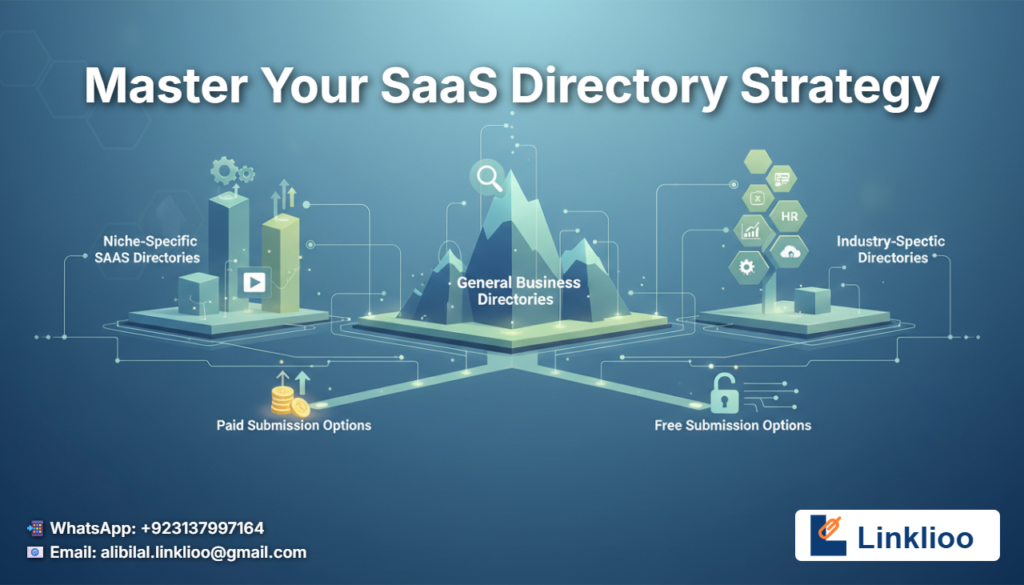
Selecting the right SaaS directories is a foundational step for growth teams aiming to boost domain authority and lead generation. Not all platforms offer the same value; a strategic approach requires understanding where your specific target audience spends their time.
Categorizing these platforms allows marketing managers to prioritize submissions based on current business goals, whether that is immediate traffic or long-term SEO.
General Business Directories
General business directories serve as broad ecosystems that document the tech landscape. They are often the first stop for investors, journalists, and early adopters looking for the next big solution.
Examples (e.g., Crunchbase, Product Hunt, AngelList)
Crunchbase is the gold standard for firmographic data, while Product Hunt is essential for generating initial launch momentum and community feedback. Wellfound (formerly AngelList) remains a primary hub for connecting with the startup talent pool.
Pros and Cons for SaaS
The primary advantage is high domain authority, which provides a powerful backlink to your site. However, the high noise levels on these platforms can lead to lower conversion rates compared to specialized review sites.
Niche-Specific SaaS and Software Directories
These platforms are built specifically for software comparison and user reviews. They dominate search engine results pages (SERPs) for high-intent keywords like “best project management software.”
Examples (e.g., G2, Capterra, Software Advice, GetApp)
G2 and Capterra are the industry leaders, leveraging millions of user reviews to rank products. Software Advice and GetApp offer more tailored discovery experiences for specific business sizes and needs.
High relevance and targeted audience
Users visiting these sites are typically in the middle or bottom of the funnel. They are actively comparing features, pricing, and social proof, making this traffic highly valuable for sales teams.
Industry-Specific Directories
Industry-specific directories focus on vertical markets rather than general software categories. These are essential for products that serve a very specific niche or professional group.
For specific verticals (e.g., Marketing Automation, HR Tech)
Specialized lists for HR Tech or FinTech cater to professionals who need tools that meet strict compliance or functional standards. These directories often have higher trust levels within their respective communities.
Hyper-targeted visibility
While the total traffic volume may be lower than general sites, the lead quality is often superior. The hyper-targeted nature of these directories ensures your product is seen by decision-makers with specific pain points.
Paid vs. Free Submission Options
Most directories operate on a freemium model. Deciding whether to invest in a premium listing is a critical decision for growth marketers managing a limited budget.
Evaluating ROI for paid listings
Paid placements can drastically increase your visibility in competitive categories. However, you must carefully track the Cost Per Acquisition (CPA) to ensure the lead quality justifies the monthly spend.
Leveraging free opportunities
Every SaaS founder should maximize free profiles across all major platforms first. This builds a baseline of “low-hanging fruit” SEO benefits and ensures your brand is present whenever a potential customer performs a search.
Navigating the Landscape: Types of SaaS Directories
Selecting the right SaaS directories is a foundational step for growth teams aiming to boost domain authority and lead generation. Not all platforms offer the same value; a strategic approach requires understanding where your specific target audience spends their time.
Categorizing these platforms allows marketing managers to prioritize submissions based on current business goals, whether that is immediate traffic or long-term SEO.
General Business Directories
General business directories serve as broad ecosystems that document the tech landscape. They are often the first stop for investors, journalists, and early adopters looking for the next big solution.
Examples (e.g., Crunchbase, Product Hunt, AngelList)
Crunchbase is the gold standard for firmographic data, while Product Hunt is essential for generating initial launch momentum and community feedback. Wellfound (formerly AngelList) remains a primary hub for connecting with the startup talent pool.
Pros and Cons for SaaS
The primary advantage is high domain authority, which provides a powerful backlink to your site. However, the high noise levels on these platforms can lead to lower conversion rates compared to specialized review sites.
Niche-Specific SaaS and Software Directories
These platforms are built specifically for software comparison and user reviews. They dominate search engine results pages (SERPs) for high-intent keywords like “best project management software.”
Examples (e.g., G2, Capterra, Software Advice, GetApp)
G2 and Capterra are the industry leaders, leveraging millions of user reviews to rank products. Software Advice and GetApp offer more tailored discovery experiences for specific business sizes and needs.
High relevance and targeted audience
Users visiting these sites are typically in the middle or bottom of the funnel. They are actively comparing features, pricing, and social proof, making this traffic highly valuable for sales teams.
Industry-Specific Directories
Industry-specific directories focus on vertical markets rather than general software categories. These are essential for products that serve a very specific niche or professional group.
For specific verticals (e.g., Marketing Automation, HR Tech)
Specialized lists for HR Tech or FinTech cater to professionals who need tools that meet strict compliance or functional standards. These directories often have higher trust levels within their respective communities.
Hyper-targeted visibility
While the total traffic volume may be lower than general sites, the lead quality is often superior. The hyper-targeted nature of these directories ensures your product is seen by decision-makers with specific pain points.
Paid vs. Free Submission Options
Most directories operate on a freemium model. Deciding whether to invest in a premium listing is a critical decision for growth marketers managing a limited budget.
Evaluating ROI for paid listings
Paid placements can drastically increase your visibility in competitive categories. However, you must carefully track the Cost Per Acquisition (CPA) to ensure the lead quality justifies the monthly spend.
Leveraging free opportunities
Every SaaS founder should maximize free profiles across all major platforms first. This builds a baseline of “low-hanging fruit” SEO benefits and ensures your brand is present whenever a potential customer performs a search.
Your Step-by-Step SaaS Directory Submission Strategy
Executing a precise SaaS directory submission strategy is one of the most effective ways to build high-quality backlinks and drive qualified referral traffic. By listing your software on reputable platforms, you signal authority to search engines while placing your product directly in front of active buyers.
Research and Identify High-Value Directories
Success begins with identifying where your potential customers spend their time researching solutions. A spray-and-pray approach leads to wasted resources, so focus on platforms that offer the highest ROI for your specific niche.
Competitor analysis (where are they listed?)
Start by analyzing your direct competitors to see which directories are fueling their organic growth. Use tools like Ahrefs or Semrush to check their backlink profiles and identify recurring directory domains.
Keyword research for relevant directories
Search for terms like “[your niche] software” or “best [category] tools” to see which directories rank on the first page. These high-ranking listicles are the primary targets for your submission efforts.
Criteria for selecting directories (DA, traffic, relevance)
Prioritize directories with a high Domain Authority (DA) and significant monthly traffic. Ensure the platform is relevant to your industry to ensure the link equity passed to your site is contextually valuable.
Prepare Your Optimized Listing Content
Your listing is often the first touchpoint a prospect has with your brand. It must be professionally crafted to convert browsers into trial users while remaining optimized for internal directory search engines.
Crafting a compelling company description
Write a concise, benefit-driven description that clearly explains the problem your SaaS solves. Avoid jargon and focus on the unique value proposition that sets you apart from competitors.
Keyword integration (product features, benefits)
Naturally weave your primary and secondary keywords into the description and feature lists. This helps the directory’s internal search algorithm categorize your software correctly and surface it to relevant users.
High-quality visuals (logos, screenshots)
Upload high-resolution logos and clear, annotated screenshots of your user interface. Visual proof of a clean, functional product significantly increases click-through rates and user trust.
Consistent NAP (Name, Address, Phone) information
Maintain strict consistency with your company Name, Address, and Phone number across every platform. Uniform NAP data is a critical trust signal for search engines and helps solidify your brand’s digital footprint.
The Submission Process: Best Practices
The submission phase requires attention to detail to ensure your profile is approved quickly and performs well. Complete every section of the application to maximize your visibility within the platform.
Creating a consistent profile across platforms
Ensure your branding, tone of voice, and messaging remain uniform across all directories. This consistency builds brand recognition and professional credibility as users encounter your software in multiple places.
Utilizing all available fields (pricing, features, integrations)
Never leave optional fields blank, as these are often used as filters by potential buyers. Detailed information about pricing tiers and native integrations helps qualify leads before they even reach your website.
Encouraging user reviews and testimonials
Social proof is the primary driver of conversions on directory sites. Implement a system to encourage your happiest customers to leave honest reviews, as listings with higher ratings receive significantly more exposure.
Post-Submission: Monitoring and Maintenance
A successful SaaS directory submission strategy does not end once the “submit” button is clicked. Ongoing management ensures your listings remain accurate and continue to generate high-quality leads over time.
Tracking approval status
Keep a centralized spreadsheet to track which directories have approved your listing and which are still pending. Follow up with editors if a submission remains in limbo for more than a few weeks.
Regularly updating information
Update your listings whenever you launch new features, change your pricing, or refresh your branding. Outdated information can frustrate potential customers and lead to a poor first impression of your product.
Responding to reviews and inquiries
Engage actively with users who leave feedback or ask questions on your directory profiles. Prompt, professional responses to both positive and negative reviews demonstrate that your team is attentive and committed to customer success.
Common Pitfalls and How to Avoid Them
Executing a successful SaaS directory submission strategy requires precision and a long-term perspective. Many marketing managers rush the process, leading to errors that hinder growth rather than accelerate it.
The “Spammy” Approach: Quantity Over Quality
Negative impact on SEO and brand reputation
Automating submissions to hundreds of low-quality sites triggers red flags for search engine algorithms. This behavior can lead to ranking penalties and associates your brand with “link farms,” damaging your professional image.
Focus on relevance, not just numbers
Prioritize high-authority platforms that cater specifically to your niche or software category. A single listing on a reputable site like G2 or Capterra is worth significantly more than dozens of entries on obscure lists.
Inconsistent or Incomplete Information
Damaging user trust and search engine signals
Discrepancies in your product description, pricing, or contact details create confusion for potential buyers. Search engines also rely on consistent data to verify your brand’s legitimacy and authority across the web.
Importance of data accuracy
Maintain a centralized document containing your “source of truth” for all company details. Ensure every submission reflects the most current version of your value proposition and technical specifications.
Neglecting User Reviews and Engagement
Missed opportunities for feedback and social proof
A static listing without user interaction appears stagnant and untrustworthy to modern software buyers. SaaS prospects rely heavily on peer reviews to validate their purchasing decisions and assess product reliability.
Strategies for review generation and management
Implement automated email workflows to encourage satisfied customers to leave feedback on key directories. Actively responding to both positive and negative reviews demonstrates a commitment to transparency and customer success.
Forgetting to Track Performance
Lack of insights into ROI
Without proper attribution, it is impossible to determine which directories are driving actual business value. You risk wasting resources on platforms that do not contribute to your bottom line or user acquisition goals.
Inability to refine strategy
Continuous improvement requires data-driven decision-making to identify high-performing channels. Tracking allows you to double down on what works and pivot away from ineffective platforms that offer no engagement.
Measuring Success: KPIs for Your Directory Submission Efforts
To justify the investment in directory listings, you must establish a framework for measuring effectiveness. This ensures your efforts align with broader growth objectives and provide a clear return on investment.
Key Metrics to Track
Referral traffic from directories
Monitor the volume of users clicking through to your website from specific listing pages. This metric indicates the quality of the audience and the relevance of the platform to your target market.
Backlink growth and domain authority
High-quality directories provide valuable links that strengthen your site’s backlink profile. Over time, these links contribute to higher domain authority and improved search visibility for your core product pages.
Keyword ranking improvements
Observe how your organic rankings change for target keywords associated with your software category. Successful submissions often lead to improved performance in competitive search results through increased brand relevance.
Lead generation and conversions
Track how many sign-ups or demo requests originate from your directory profiles using conversion tracking. This is the ultimate indicator of whether your presence on these platforms is driving revenue.
Brand mentions and sentiment
Keep an eye on the broader conversation surrounding your brand across different review sites. Positive sentiment and increased brand mentions contribute significantly to your overall market authority and trust.
Tools for Monitoring and Analysis
Google Analytics
Use UTM parameters on your listing URLs to segment and analyze traffic sources within Google Analytics. This allows you to see the exact behavior of users coming from each specific directory.
Google Search Console
Review the “Links” report to see which directories are being recognized by Google as backlink sources. This tool also helps you monitor the search queries that lead users to your listings.
SEO tools (Ahrefs, Semrush, Moz)
Utilize professional SEO suites to track your domain authority and keyword movements over time. These tools provide deep insights into your competitors’ directory strategies and your relative market position.
Integrating Directory Submission into Your Overall SaaS SEO Strategy
Effective directory submission is not a standalone tactic; it is a foundational pillar of a comprehensive SaaS growth engine.
When executed with precision, these listings serve as authoritative nodes that validate your software’s presence within the digital ecosystem.
Integrating these submissions ensures your brand remains visible where your target users are actively comparing solutions.
This alignment transforms a simple link-building exercise into a strategic asset for long-term organic performance.
Synergy with Content Marketing
Your directory presence and content engine should work in tandem to capture and convert high-intent traffic.
Using directory profiles to promote content
Many high-tier directories allow you to include links to specific resources, such as whitepapers or case studies.
Use these fields to direct potential users toward your most valuable bottom-of-funnel content.
Content supporting directory listings
Create blog posts or comparison pages on your own site that reference your presence on major review platforms.
This cross-linking builds trust with both users and search engine crawlers, reinforcing your market authority.
Complementing On-Page SEO
The data you provide to directories must mirror the optimization efforts occurring on your primary domain.
Consistency of keywords and brand messaging
Ensure that your product descriptions and core value propositions are consistent across all platforms.
Uniform messaging reinforces your brand identity and helps search engines associate your site with specific, high-value keywords.
Strengthening Technical SEO
Directories provide more than just referral traffic; they offer technical advantages that boost your site’s health.
High-quality backlinks contributing to crawlability and authority
Links from reputable SaaS directories act as “votes of confidence” that increase your domain authority.
These high-quality backlinks also help search engine bots discover and index your pages more efficiently.
Conclusion: Powering Your SaaS Startup’s Organic Growth
Dominating the search results requires a multi-faceted approach where every external link serves a specific purpose.
By treating directory listings as a strategic component, you build a resilient foundation for sustainable user acquisition.
Recap of Key Takeaways
Success in the competitive SaaS landscape demands a focus on both visibility and credibility.
Strategic importance for startups
For early-stage companies, these listings provide the initial authority needed to compete with established incumbents.
They bridge the gap between a new product launch and a fully matured organic search presence.
Focus on quality, consistency, and measurement
Prioritize high-authority niche directories over low-quality bulk submissions to avoid search engine penalties.
Continuously monitor your referral traffic and conversion rates to refine your placement strategy over time.
Your Next Steps for SEO Domination
The best time to solidify your digital footprint is before your competition scales their efforts.
Call to action for readers to start their strategy
Audit your current external listings and identify the top five industry-specific directories where your product is missing.
Begin your submission process today to start claiming your share of the organic search market.
Emphasize long-term benefits
The compounding effects of a well-integrated SEO strategy will lower your customer acquisition costs significantly.
Stay committed to quality, and your SaaS brand will become a dominant force in your category.







Add comment