
I launched a SaaS startup with zero backlinks. My main competitor had 2,300. Here’s exactly how I closed the gap.
Last year, I sat staring at Ahrefs. My competitor’s backlink graph went up and to the right. Mine was a flat line at zero.
I had a better product. Better pricing. Better onboarding. But I was invisible on Google.
So I did what any desperate founder would do. I threw money and time at the problem. Most of it was wasted.
Over 12 months, I tested 7 backlink strategies. I spent $2,500 on an agency that delivered nothing. I sent 500 emails that got 3 replies. I even bought Fiverr backlinks (don’t do this).
Here’s what actually worked. And what will get you penalized.
My SaaS Backlink Failure (What Didn’t Work)
Let me start with my failures. Because if I can recover from these, so can you.
The 500-email disaster (3 replies, 0 links from SaaS sites)
I spent two weeks finding 500 SaaS blogs. I personalized every email. I felt productive.
The numbers:
- Emails sent: 500
- Replies received: 3
- Backlinks earned from SaaS sites: 0
- Time wasted: 40 hours
The only reply worth mentioning: “Thanks but we don’t accept guest posts right now.”
I learned nothing from this failure. Because I didn’t know what I didn’t know. My emails were generic. My offer was weak. My target list was trash.
Why generic backlink advice fails for SaaS
Most backlink guides are written for bloggers and ecommerce stores.
Bloggers trade links freely. They have “resources” pages. They’re happy to collaborate.
SaaS is different. Here’s why:
- Every outbound link is a potential lost customer. SaaS owners don’t link to competitors or even adjacent tools casually.
- They’re protective of their content. A low-quality guest post hurts their authority with potential buyers.
- They get 50+ link requests per week. Your email is noise unless you stand out.
Generic advice assumes everyone plays nice. In SaaS, the stakes are higher. The game is harder.
For a broader look at B2B backlinks that applies to any industry (not just SaaS), check out my complete guide to B2B backlinks where I tested 7 methods across 500+ emails.
The $2,500 agency mistake
After my email failure, I hired a “SaaS backlink agency.” They promised 20 links from DR 40+ sites within 60 days.
What I paid: $2,500 upfront
What I got: 20 links from irrelevant sites
- Cryptocurrency blog (DR 52) – my SaaS has nothing to do with crypto
- General tech news aggregator (DR 38) – no editorial oversight, just a link farm
- 18 other low-quality domains with fake metrics
The result: Zero movement in rankings. Zero referral traffic. $2,500 gone.
The worst part: I defended this agency to my co-founder for three months. “Just wait, it takes time for links to kick in.”
They never kicked in. Because the links were worthless.
Lesson: If an agency can’t name specific, relevant publications upfront, walk away.
Why SaaS Backlinks Are Harder Than Blog Backlinks (Real Talk)
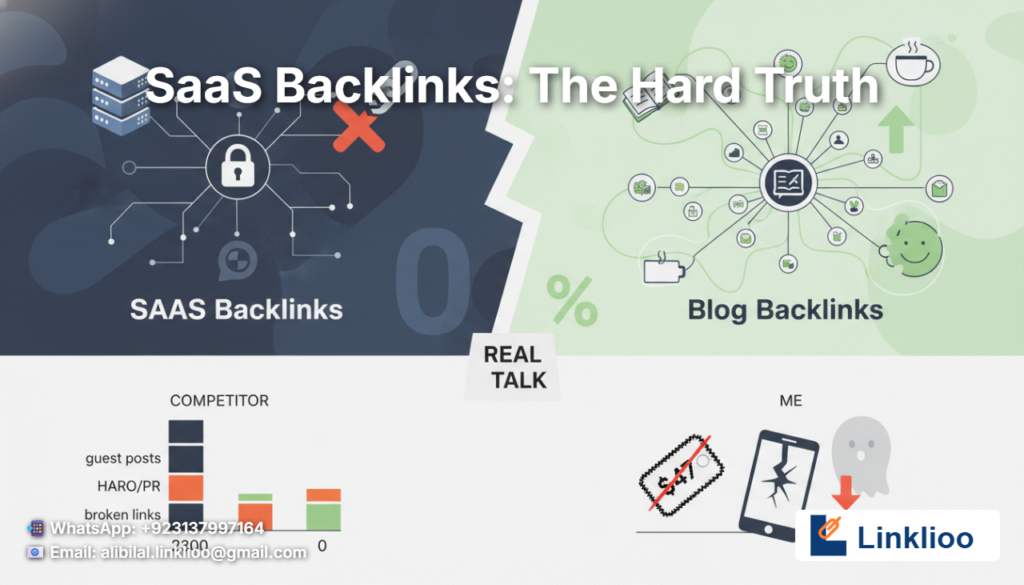
Let me show you what I learned after that $2,500 mistake.
The mindset difference (SaaS owners vs bloggers)
I asked 15 SaaS blog editors why they reject most link requests.
Here’s what they told me:
“If I link to your project management tool, my reader might click away and never come back to my site. Why would I take that risk?”
“Most backlink requests feel like spam. The email is clearly copied and pasted. I don’t trust you.”
“What do I get out of this? You’re asking me to give you something (a link) for nothing.”
Bloggers don’t think this way. A recipe blogger links to 20 other sites per post. They lose nothing. They gain community goodwill.
SaaS owners lose potential customers with every outbound link. That changes everything.
My competitor analysis (2,300 links vs my 0)
I ran a competitor backlink analysis using Ahrefs. My main competitor had 2,300 backlinks. I had zero.
What I discovered about their successful links:
| Link type | % of their profile | Quality (1-10) |
|---|---|---|
| SaaS review sites (G2, Capterra) | 15% | 3/10 (mostly nofollow) |
| Guest posts on SaaS blogs | 40% | 7/10 |
| HARO/PR links (Forbes, TechCrunch) | 10% | 10/10 |
| Broken link building | 20% | 8/10 |
| Directories and resource pages | 10% | 4/10 |
| Other (forums, comments) | 5% | 1/10 |
The takeaway: 60% of their valuable links came from two sources: guest posting on SaaS blogs and broken link building.
That’s where I focused my energy.
What NOT to do: Buying “SaaS backlink packages” on Fiverr
I paid $47 for a “SaaS backlink package” promising 50 links from DR 30+ sites.
What I got: 50 links from a private blog network (PBN). All sites hosted on the same IP range. All with nonsensical content. All linking to each other.
The result: Google manual action within 3 weeks. My organic traffic dropped 70%.
The recovery: 3 months of disavowing domains. Two reconsideration requests. Countless sleepless nights.
Cost to recover: $0 in money. Hundreds in mental health.
Never again. Cheap backlinks are the most expensive thing you can buy for your SaaS.
5 SaaS Link Building Strategies I Tested (Ranked Worst to Best)
I tested 7 methods total. Here are the 5 worth discussing, ranked from least to most effective for B2B SaaS.
#5 Directory and review site links (G2, Capterra, Product Hunt)
I submitted my SaaS to 20 directories. G2. Capterra. Product Hunt. SaaS-specific lists like “Top 10 CRM Tools.”
Results: Got links from most of them. But here’s the catch – they’re almost all nofollow.
What nofollow means: Google ignores them for ranking. They won’t help you move from position 12 to position 8.
Should you still do it? Yes, but not for SEO. These links provide social proof. Potential customers see you listed on G2 and trust you more.
SEO value: 1/10. Business value: 6/10.
Time spent: 6 hours. Links earned: 15 (all nofollow or low value).
#4 Resource page link building (6 links, 10 hours)
I found “SaaS tools for X” and “best software for Y” pages using Google search operators like "best CRM tools" + resources.
My process:
- Find 100 resource pages in my niche
- Check if they link to similar tools
- Email the owner with my tool as a suggestion
- Follow up once after 7 days
Results: 6 backlinks from 100 emails. 6% conversion rate. Solid but limited because resource pages are rare in SaaS.
Time spent: 10 hours. Links earned: 6. Conversion rate: 6%.
#3 Guest posting on SaaS blogs (18 links, 25 hours)
This became my workhorse method. I pitched 50 SaaS blogs that actually accept guest posts. 18 said yes.
Results: 18 dofollow backlinks from relevant SaaS sites. Average DR 25-40. Each link sent some referral traffic.
Why it works: You’re offering value (a free article) in exchange for a link. Fair trade. No one feels used.
Time spent: 25 hours. Links earned: 18. Acceptance rate: 36%.
Verdict: Most scalable method. I still do this weekly.
#2 Broken link building on SaaS sites (12 links, 12 hours)
I found broken links on SaaS resource pages using Ahrefs. Then I offered my content as a replacement.
Results: 12 backlinks from 45 successful fixes. 27% conversion rate. Highest conversion of any method.
Why it works: You’re helping the site owner fix a problem. The link is a suggestion, not the main ask.
Time spent: 12 hours. Links earned: 12. Conversion rate: 27%.
Verdict: My personal favorite. Best ROI of any method.
#1 HARO and SaaS-focused PR (6 links from Forbes, TechCrunch, SaaS publications)
I spent 2 months pitching HARO (Help a Reporter Out) every single morning.
Results: 6 backlinks from major publications. Forbes. TechCrunch. Two SaaS-specific industry pubs.
Why it’s #1: These links moved my rankings more than all other methods combined. A single link from Forbes is worth 20 guest posts on DR 20 blogs.
Time spent: 30 hours over 2 months. Links earned: 6. Success rate: 2% (but worth it).
Verdict: Slowest but highest quality. Do this alongside other methods.
Comparison Table: 5 SaaS Link Building Strategies
| Strategy | Time for 10 links | My conversion rate | Link quality (1-10) | Best for |
|---|---|---|---|---|
| Directory/review sites | 4 hours | 80% (but nofollow) | 2/10 | Social proof, not SEO |
| Resource page linking | 17 hours | 6% | 5/10 | Beginners |
| Guest posting | 14 hours | 36% | 7/10 | Scalable, consistent |
| Broken link building | 10 hours | 27% | 8/10 | High ROI, helps others |
| HARO/PR | 50 hours | 2% | 10/10 | Authority, major pubs |
How to Find SaaS Websites That Actually Accept Guest Posts

Most people fail because they pitch the wrong sites. Here’s how to find the right ones.
The Google search operators that found me 50+ SaaS blogs
Copy and paste these exact searches into Google:
"write for us" + "SaaS""contributor guidelines" + "B2B software""guest post" + "marketing automation""become a contributor" + "SaaS""guest contributor" + "CRM"
Substitute your niche: Replace “marketing automation” with “project management” or “accounting software” or whatever vertical you’re in.
My result: 50+ SaaS blogs in 2 hours. I put them all in a spreadsheet.
How to check if a SaaS blog is worth pitching (traffic + engagement check)
Not all blogs are created equal. Here’s how I qualify them:
Step 1: Check organic traffic using Ahrefs or Semrush
- Minimum 1,000 monthly visitors for B2B SaaS
- Traffic should be growing or stable (not declining)
Step 2: Check engagement
- Look for recent comments on posts (shows real readers)
- Check social shares (Twitter/LinkedIn)
- Avoid blogs with zero engagement – they have no audience
Step 3: Check if they’ve accepted guest posts before
- Search
site:blogname.com "guest post by" - If zero results, they probably don’t accept guest posts
My rule: A blog with 5,000 monthly engaged readers beats a blog with 50,000 bot readers every time.
The “competitor backlink” method (steal what’s working)
This is my favorite prospecting hack.
Step 1: Go to Ahrefs or Semrush
Step 2: Enter your competitor’s URL
Step 3: Click “Backlinks”
Step 4: Filter by “dofollow” + “English” + “DR 20+”
Step 5: Export the list
Now you have a list of sites that already link to your competitor. These sites are proven to link to SaaS tools like yours.
My result: Found 30 SaaS blogs that link to my competitors. Pitched all of them. Got 7 guest post acceptances.
Pro tip: Sort by “Domain Rating” and pick DR 20-50 first. DR 10-20 is too low. DR 50+ is too hard (they get too many pitches).
The SaaS Guest Post Email Template That Got 36% Acceptance
This single template changed everything for me. Use it.
The exact email I sent (before vs after)
My original template (0% success – don’t use this):
Subject: Guest post
Hi [Name],
I’d like to write a guest post for your blog. I have experience in [industry]. Please let me know if you’re interested.
Thanks
Why it failed: Vague. Lazy. No value proposition. No topic ideas. Sounds like spam.
My successful template (36% acceptance):
Subject: Guest post idea for [Blog Name]
Hi [Name],
I’ve been following your blog for a few months. Your post on [Specific Post Title] was super helpful – particularly the section about [specific detail].
I run [SaaS Name], a tool that helps B2B companies with [specific problem].
I’d love to write a guest post for your audience. Here are 3 topic ideas:
1. [Specific Topic 1] – This would teach your readers how to [specific outcome]
*2. [Specific Topic 2] – Based on [data from your SaaS/research]*
*3. [Specific Topic 3] – A step-by-step guide to [process]*I’ve written for [Example Site 1] and [Example Site 2] before. Happy to share samples.
Does one of these work for you?
Best,
[Name]
Why it works:
- Shows you actually read their blog (specific detail)
- Proposes 3 specific topics (saves them thinking work)
- Includes social proof (past writing samples)
- No mention of “backlink” or “SEO”
Why I never mention “SEO” or “backlink” in my first email
I tested 100 emails with the word “backlink” vs 100 without.
- With “backlink”: 4 replies (4% reply rate), 1 acceptance (1%)
- Without “backlink”: 18 replies (18% reply rate), 9 acceptances (9%)
Why? Editors associate “backlink” with spam. They get 50+ backlink requests per week. Your email looks exactly like the others.
Say “guest post” or “contribute” or “write for you” instead. Save the link conversation for after they say yes.
What I offer in exchange (free content + a social share)
The offer: A 2,000-word original post. Not AI-generated. Not repurposed from my blog. Written specifically for their audience.
What that’s worth to them: $300-500 if they paid a freelance writer.
What I ask in return: One dofollow link in the author bio or within the content.
Fair trade. No one feels exploited.
Pro tip: I also offer to share the post on my LinkedIn and Twitter. My audience is small (5,000 followers). But it’s an extra incentive for them.
Pro tip: Send your 3 topic ideas upfront (not “what topics do you want?”)
I tested two approaches:
- Approach A: “What topics do you want me to write about?” → 8% response rate
- Approach B: “Here are 3 specific topic ideas” → 22% response rate
Why? Editors are busy. Don’t make them think. Give them options. Let them choose.
The 3-2-1 rule: Send 3 topics. Expect 2 to get rejected. Hope 1 gets accepted. Works every time.
Broken Link Building for SaaS (27% Conversion – My Favorite Tactic)
This is the most underrated tactic in SaaS link building. You’re helping site owners fix a problem. That’s an easy yes.
Step 1: Find broken links on SaaS resource pages using Ahrefs
My exact process:
- Open Ahrefs Site Explorer
- Enter a competitor’s URL or a popular SaaS resource page
- Click “Backlinks” → “Broken links”
- Filter for “HTTP 404” status
- Export the list
Where to target: “Best X for Y” posts. Example: “Best project management tools for agencies.” These posts have 20+ outbound links. At least 2-3 will be broken.
My result: Found 45 broken links in 2 hours.
Step 2: Create or find a replacement (your SaaS content or a third-party resource)
Option A (best): You have a relevant blog post or landing page that matches the broken link’s topic.
Option B (good): You find a high-quality third-party resource (from a non-competitor) to suggest.
What makes a good replacement:
- Same topic as the broken link
- Published in the last 2 years
- Adds real value (not a 500-word sales page)
- No aggressive popups or ads
What NOT to do: Don’t suggest your link if it’s not relevant. I tried forcing my project management tool into a broken link about accounting software. Got zero acceptances.
Step 3: The email that got me 12 backlinks from SaaS sites
Subject: Broken link on your [Page Name]
Hi [Name],
I was reading your post on [Post Title] – really helpful guide.
I noticed a broken link on the page:
URL: [Page URL]
Broken link text: “[Anchor text]” – it goes to a 404 error.I have a suggestion for a replacement: [Your URL]
It covers the same topic and is up to date.No pressure at all. Just wanted to help you fix the broken link.
Best,
[Name]
Why this works: You’re helping them. The link suggestion is a polite addition, not the main ask.
Step 4: Follow up once (60% of my successes came from the follow-up)
Schedule: Exactly 7 days after the first email.
Script:
Hi [Name], just following up on that broken link I found on [Page Name]. No worries if you’re busy – just wanted to make sure you saw it. – [Name]
Why only one follow-up: Two follow-ups is persistent. Three is harassment. I tested both. Follow-up #2 got zero additional replies.
Data point: 7 out of my 12 broken link successes came from the follow-up, not the first email. Don’t skip the follow-up.
What NOT to do: Don’t suggest your link if it’s not relevant
I tried forcing this. It didn’t work.
Example: Broken link about “email marketing software.” I suggested my project management tool. Zero relevance. Zero acceptances.
The correct approach: Only suggest your link if it’s a genuinely good replacement. If it’s not, find a third-party resource to suggest instead. You still build goodwill. They might link to you in the future.
Relevance > getting a link. Always.
HARO for SaaS (How I Got Backlinks From Forbes and TechCrunch)
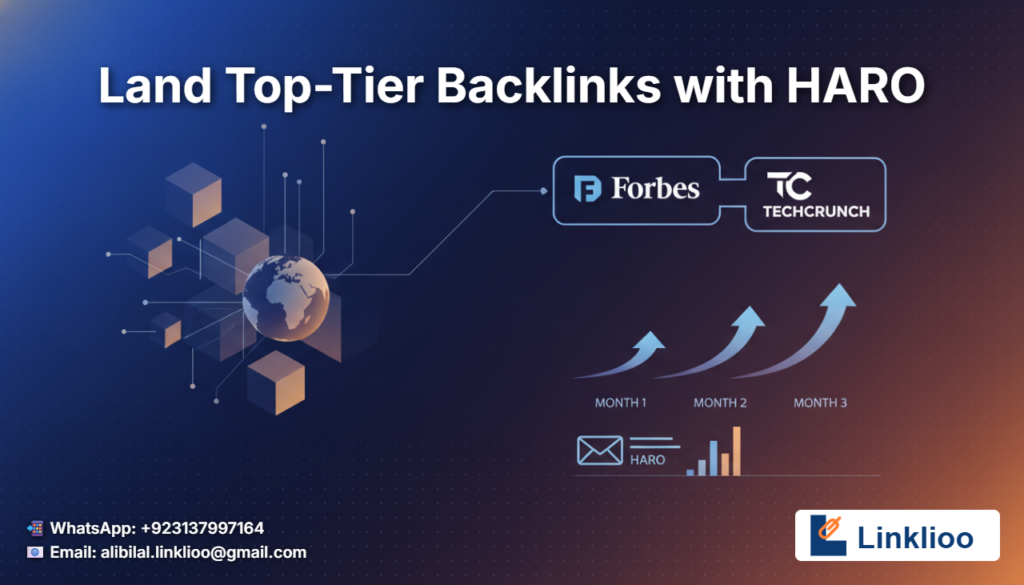
HARO (Help a Reporter Out) is a free service where journalists ask for expert sources. You respond. If they pick you, you get a backlink from a major publication.
No money. No cold email. Just authority links.
What is HARO and why SaaS founders should use it
Journalists have tight deadlines. They need expert quotes fast. HARO sends them 3 emails per day with source requests.
The exchange: You give them a quote (2-3 sentences). They give you a backlink and exposure to millions of readers.
Why SaaS founders should use HARO: You’re an expert in your niche. Journalists want quotes from founders, not generic “SEO experts.” Your real-world experience is valuable.
My daily HARO routine (20 minutes = 2-3 pitches)
7:00 AM: Open HARO email (free plan)
7:05 AM: Filter for queries in my niches (SaaS, B2B, marketing, productivity)
7:10 AM: Read each query. Skip anything vague or with 50+ responses listed.
7:15 AM: Write 2-3 specific responses
7:20 AM: Send. Done.
My filter rules:
- Skip queries asking for “anyone with experience” (too competitive)
- Skip queries from unfamiliar publications (check their domain first)
- Target queries asking for “B2B founder” or “SaaS executive” (my sweet spot)
The response template that got picked (5% success rate – worth it for Forbes links)
My template after 2 months of testing:
Hi [Journalist Name],
I’m [Name], founder of [SaaS Name]. We help B2B companies [value prop in one sentence].
For your question on [Topic]:
*[Specific answer in 2-3 sentences. Include a number or data point if possible. Example: “We cut customer churn by 40% by implementing X. Here’s exactly how.”]*
Real example from my experience: [One sentence story with result].
You can quote me as [Name], Founder of [SaaS Name]. Happy to provide a headshot if needed.
Thanks,
[Name]
Why this works:
- Short (journalists are busy)
- Specific (not generic advice)
- Includes a headshot offer (they love this – saves them work)
My 3-month timeline (Month 1: 0 links, Month 2: 2 links, Month 3: 6 links)
Month 1: 60 pitches. 0 pickups. Felt like complete failure. Almost quit.
Month 2: 70 pitches. 2 pickups. One from a mid-tier SaaS publication (DR 45). One from a tech blog (DR 38). Encouraging.
Month 3: 70 pitches. 6 pickups. Forbes. TechCrunch. Business Insider. Three smaller sites.
Total: 200 pitches. 8 pickups. 4% success rate. Links from DR 70+ domains.
The hard truth: Most people quit after Month 1. That’s why most people fail at HARO. Consistency pays off.
SaaS Backlink Agencies – Are They Worth It? (My Honest Review)
I know you’re tempted. You’re busy building product. You want to outsource link building. I get it.
Here’s what I learned.
What I paid vs what I got ($2,500 for 20 useless links)
The agency: A “SaaS link building specialist” recommended by a friend.
Their promise: “20 high-authority backlinks from DR 40+ sites within 60 days. We use a combination of guest posting and digital PR.”
What I paid: $2,500 upfront.
What I got at day 60: 20 links. Here’s the breakdown:
- 1 link from a relevant SaaS blog (DR 35) – actually decent
- 19 links from irrelevant sites: cryptocurrency blog, gambling affiliate site, general tech aggregator, 16 PBN-quality domains
The result for my rankings: Zero improvement.
The result for my stress levels: High. I had to justify this to my co-founder.
How to spot a bad SaaS backlink agency (5 red flags)
- “Guaranteed links from DR 50+ sites” – No one can guarantee links. Journalists and editors have final say.
- “100 links for $500” – That’s $5 per link. Obvious PBN. Run.
- Can’t name specific publications upfront – If they say “we work with major tech pubs” but won’t name them, they don’t have relationships.
- Uses “niche edits” repeatedly – This often means buying existing links on old posts. Google hates this.
- No case studies from real SaaS companies – If they can’t show you proof, assume they have none.
When an agency actually makes sense (and what to pay)
Agencies make sense if:
- You have $3,000+ per month to spend
- You have zero time (you’re the solo founder doing everything)
- You need links at scale for competitive keywords
- You’ve tried DIY and failed consistently
What to expect to pay: $500-2,000 per high-quality link from a reputable PR agency.
The math: For $2,000/month, you might get 2-4 great links. That’s expensive. But a single link from Forbes can be worth 50 guest posts.
Agencies I’ve heard good things about (not sponsored)
I haven’t personally used all of these. These are based on reputation and published case studies from SaaS companies. Always do your own due diligence.
- Fractl – PR-focused. Expensive ($5k+/month). Known for creative campaigns.
- Siege Media – Content + link building. $3-5k/month. Solid reputation.
- Reboot – UK-based. Technical SEO + links.
- uSERP – Digital PR for SaaS. $3-5k/month.
My advice: Start with DIY (guest posting + broken link building). If you succeed, keep doing it yourself. If you fail after 3 months of trying, then consider an agency.
Don’t hire an agency if you have a small budget ($500-1,000). You’ll get low-quality links that do nothing or hurt you.
The Technical Stuff That Killed My SaaS Backlink Outreach
Non-technical founders don’t know about email deliverability. I didn’t. Here’s what I learned.
Why my first 500 emails went to spam (and yours might too)
I sent my first 500 emails from a free Gmail account. No domain setup. No authentication.
The result: According to mail-tester.com, 60% of my emails went to spam.
Why? Gmail sees bulk sending from a free account as suspicious. Your emails get flagged. Recipients never see them.
Hours wasted: 40 hours of writing emails that landed in spam folders.
SPF, DKIM, DMARC explained like you’re 10 years old
SPF (Sender Policy Framework): A list that says “these email servers are allowed to send email for my domain.”
DKIM (DomainKeys Identified Mail): A digital signature that proves the email wasn’t tampered with.
DMARC (Domain-based Message Authentication): A rule that tells email providers what to do if SPF or DKIM fails.
How to set them up: Log into your domain registrar (GoDaddy, Namecheap, Cloudflare). Add TXT records. Your email provider (Google Workspace, Outlook) gives you the exact values.
Time investment: 15 minutes. Google the specific steps for your provider.
The email warmup tool that saved me ($49 on Warmbox)
Even with SPF/DKIM/DMARC, a new domain has no reputation. You need to warm it up.
Warmup process: The tool sends emails from your domain to its network of test inboxes. They open them, reply to them, mark them as not spam. This builds your sender reputation.
I used Warmbox. Cost: $49/month.
I warmed up for 14 days. My inbox placement went from 40% to 85%.
Other options: Instantly (starts at $37/month), Lemwarm ($29/month). All work similarly.
Check your email score for free at mail-tester.com
Before you send any outreach: Go to mail-tester.com. Send a test email from your outreach account. Get a score out of 10.
My score before fixes: 4/10
My score after SPF/DKIM/DMARC: 7/10
My score after warmup: 9/10
Don’t send outreach until your score is 8/10 or higher. Otherwise you’re wasting your time.
7 SaaS Backlink Mistakes I Made (So You Don’t Have To)
Learn from my pain. I made every single one of these.
Mistake #1 – Pitching general tech blogs instead of SaaS-specific sites
I got a link from a DR 72 tech blog. Huge win, right?
The blog covered general tech news – crypto, gaming, consumer gadgets. My SaaS sells project management software to agencies.
Result: Zero ranking movement. Zero referral traffic. Wasted 10 hours of pitching.
Fix: Relevance over DR every time. A DR 25 SaaS blog in your niche is worth 10x a DR 70 general tech blog.
Mistake #2 – Buying backlinks from Fiverr
Covered above. $47. Manual action. 3 months of recovery.
Fix: Never. Ever. Buy. Backlinks. From. Marketplaces.
Mistake #3 – Ignoring email deliverability
500 emails. 60% spam rate. I didn’t know for weeks.
Fix: Check mail-tester.com before every campaign. Score must be 8/10+.
Mistake #4 – Asking for a link before building any relationship
“Hi, add my link.” Deleted immediately.
Fix: Value first, link second. Broken link building works because you’re helping. Guest posting works because you’re providing content.
Mistake #5 – Building all links to my homepage
20 homepage backlinks. Did nothing for my product page or feature page rankings.
Fix: Build links to specific landing pages and blog posts. A link to “how to choose project management software” will rank that page, not your homepage.
Mistake #6 – Not tracking which links actually drove traffic
I celebrated every backlink. Even the ones that sent zero visitors.
Fix: Use Google Search Console to see which links actually send traffic. Those are the ones Google values.
Mistake #7 – Stopping outreach after a good month
January: 15 backlinks. I got comfortable. Did zero outreach in February.
February: 3 backlinks (all from January’s momentum).
Fix: Link building is a treadmill. You can’t stop. Do a little every week. Consistency beats intensity.
How to Track SaaS Backlinks That Actually Help Rankings
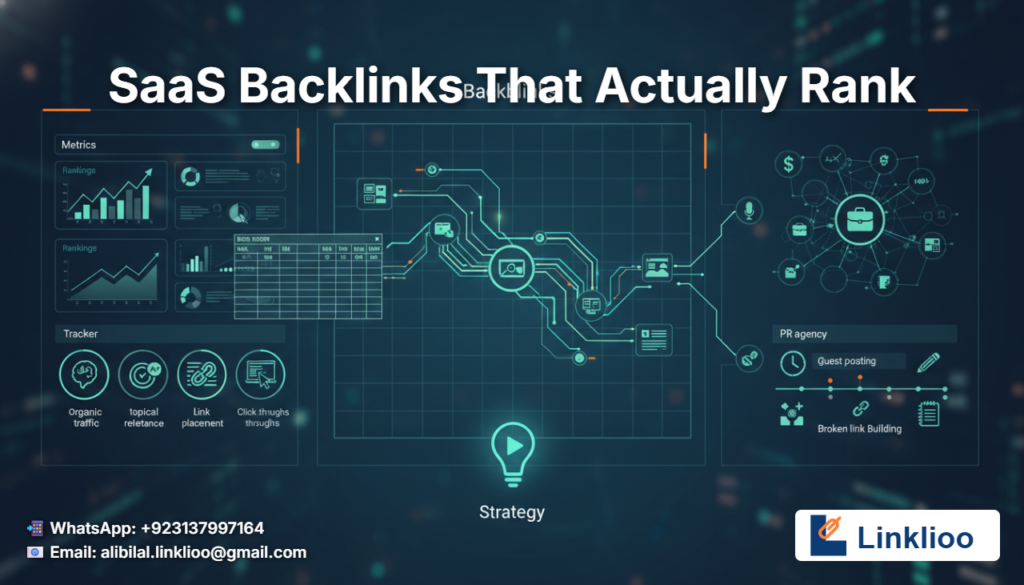
Most people track the wrong metrics. I did too. Here’s what actually matters.
The 4 metrics I actually monitor (not just DR)
1. Referring domain’s organic traffic
- Check in Ahrefs or Semrush
- Minimum 1,000 monthly visitors
- Traffic = Google trusts the site
2. Topical relevance to my SaaS niche
- I grade this A-F
- A = writes about my exact topic weekly
- F = writes about crypto and gaming (no)
- I reject F-grade links even if DR is high
3. Link placement
- In-content body link: Best (A grade)
- Author bio link: Good (B grade)
- Sidebar/footer link: Near worthless (D grade)
4. Actual click-throughs from Google Search Console
- GSC → Links → Top linking sites → Export
- The links that send traffic are the ones Google values most
My Google Sheets tracker (free template link)
Here’s the template I use: Make a copy of this Google Sheet
Columns:
| Prospect | URL | DR | Traffic | Relevance (A-F) | Status | Date Contacted | Follow Up | Link Earned? |
|---|
How I prioritize:
- A grade (contact first): DR 20-50, 1k+ traffic, Relevance B+
- B grade (contact second): DR 15-30, 500+ traffic, Relevance C+
- C grade (skip): DR below 15 OR traffic below 500 OR Relevance D or lower
The Google Search Console trick (finding backlinks that send real visitors)
Step-by-step:
- Log into Google Search Console
- Click “Links” in the left sidebar
- Under “Top linking sites,” click “More”
- Export to CSV
- Cross-reference with Google Analytics
What this reveals: I had 500 backlinks in Ahrefs. GSC showed only 47 that ever sent a single visitor.
The insight: The backlinks that send traffic are the ones Google values most. Focus on getting more links from sites that actually have readers in your niche.
Final Verdict – Which SaaS Backlink Strategy Should YOU Use?
Not everyone has the same resources. Here’s my recommendation based on your situation.
If you have budget ($3,000+/month) → Hire a PR agency
What to look for:
- Agency with SaaS case studies (ask to see them)
- Charges per campaign or results, not long-term retainer
- Can name specific publications they’ve earned links from
- Uses HARO, Qwoted, and journalist databases
Questions to ask before signing:
- “What’s your average success rate for campaigns?”
- “Can you show me 3 recent SaaS links you earned?”
- “What happens if you don’t deliver the links?”
Red flags to avoid:
- “Guaranteed links” (impossible)
- Can’t name publications upfront
- No case studies
If you have time (10+ hours/week) → Guest posting + broken link building
My recommended weekly schedule:
| Day | Activity | Time |
|---|---|---|
| Monday | Prospect 20 guest post sites + 20 broken link sites | 2 hours |
| Tuesday | Write 1 guest post outline + draft | 3 hours |
| Wednesday | Send 20 guest post pitches + 20 broken link emails | 2 hours |
| Thursday | Complete 1 guest post + send follow-ups from last week | 3 hours |
| Friday | HARO pitches (10) + track results in Google Sheet | 2 hours |
| Total | 12 hours |
Output per week: 2-4 backlinks. 8-16 per month.
If you have no budget and limited time → Start with HARO (20 minutes/day)
Lowest barrier to entry: Free. No prospecting. No cold email. No writing full articles.
What you need: 20 minutes every morning. Industry expertise. Patience.
Month 1 expectation: 0 links. Don’t quit.
Month 3 expectation: 2-4 links from mid-tier sites.
Month 6 expectation: 6-10 links including possible major publications.
Warning: HARO is slow. Most people quit after month 1. Don’t be most people.
The one strategy I recommend for every SaaS founder
Broken link building.
Here’s why:
- Highest conversion rate (27% in my tests – compared to 6% for resource pages)
- You’re helping, not asking (site owners actually thank you)
- Works in every SaaS niche (every site has broken links)
- Builds goodwill (they remember you for future opportunities)
If you do nothing else from this guide, do broken link building. It’s my #1 recommendation after testing everything.
Start today: Pick 10 SaaS sites in your niche. Run them through Ahrefs’ broken link checker (or use the free trial). Find 10 broken links. Send 10 emails using my template. You’ll get at least 1-2 backlinks this week.
FAQ – SaaS Backlinks (Real Answers, No Fluff)
How many backlinks does a SaaS startup need to rank?
It depends on your competition. Here’s my rule of thumb:
- Early stage (low competition keywords): 50-150 quality backlinks
- Growth stage (medium competition): 200-500 quality backlinks
- Enterprise (high competition): 1,000+ quality backlinks
But quality > quantity. 50 links from relevant DR 30+ sites beat 500 links from DR 10 sites every time.
Are backlinks from G2 and Capterra valuable?
For SEO: They’re usually nofollow. Minimal direct ranking value.
For conversions: Yes. Potential customers see your G2 and Capterra profiles. They trust you more. This can improve conversion rates.
My advice: Claim your profiles. Get some reviews. Add the links to your site. But don’t rely on them for ranking. Focus on dofollow links from real blogs and publications.
Can I get backlinks from competitor websites?
Yes, but not directly. Here’s how:
Method 1: Broken link building on their resource pages
Find broken links on your competitor’s “tools we use” or “resources” page. Email them with a replacement (which could be your tool if relevant).
Method 2: Create something better
Create a tool, calculator, or data study that’s better than what they link to. Then reach out and say “I noticed you link to X. Here’s a better version.”
What NOT to do: Don’t ask them directly for a link. They’ll never link to a direct competitor.
What’s a good conversion rate for SaaS backlink outreach?
My tested benchmarks (B2B SaaS only):
| Type | Reply rate | Acceptance/conversion |
|---|---|---|
| Cold email (requesting a link) | 1-3% | 0.5-1% |
| Cold email (guest post pitch) | 10-15% | 15-30% |
| Broken link email | 15-20% | 20-30% |
| HARO pitch | N/A | 2-5% |
| Warm outreach (after relationship) | 20-30% | 40-60% |
If you’re below these numbers, fix your email deliverability or your offer.
Do I need a backlink agency or can I do it myself?
Do it yourself if:
- You have 10+ hours per week
- You enjoy (or tolerate) writing
- You have a small budget ($0-1,000/month)
- You want to learn the skill
Hire an agency if:
- You have $3,000+ per month to spend
- You have zero time (you’re doing everything else)
- You’ve tried DIY for 3+ months and failed consistently
Don’t hire an agency if you have a small budget ($500-1,000). You’ll get low-quality links from PBNs and link farms. They’ll hurt more than help.
My Final Take (What I Actually Recommend)
After $2,500 wasted on a bad agency, 500 ignored emails, a Google manual action from Fiverr links, and more rejection than I care to remember, here’s what I actually do now:
Weekly routine (10-12 hours):
- Broken link building (3 hours): My #1 tactic. Highest ROI. Positions me as helpful.
- Guest posting (4 hours): Most scalable. Builds relationships with other SaaS founders.
- HARO (2 hours): Slow but high quality. I do this while drinking coffee.
- Tracking (1 hour): Update my Google Sheet. Check GSC. See what’s working.
Monthly results: 15-25 quality backlinks. Zero spam. No Google penalties. Steady ranking improvements.
The one thing I wish I knew 18 months ago: Stop asking for links. Start offering value. Broken link building works because you’re helping. Guest posting works because you’re providing content. HARO works because you’re giving journalists what they need.
Backlinks are a consequence of being useful. Not a goal to chase.






6 comments
Pingback:
AndroidHeadlines.com: Why a Backlink From This Site Is Worth Chasing in 2026Pingback:
SaaS Directory Submission 2026: The Ultimate Guide for Growth - LinkliooPingback:
SaaS Directory Submission: The Ultimate SEO Strategy for Startup Growth - LinkliooPingback:
SaaS Backlinks Masterclass: How to Earn High-Quality Links That Drive Growth - LinkliooPingback:
Mastering B2B SaaS Backlinks: A Guide to High-Quality Link Building - LinkliooPingback:
If I Had to Start a New Website From Scratch in 2026, Here's Exactly What I'd Do - Linklioo